Showing posts with label Robert Ludlum. Show all posts

Monday, October 20, 2025

The Scarlatti Inheritance by Robert Ludlum


(pb; 1971)


From the back cover

Her weapons: money and power. Her target: the most dangerous man in the world—her own son. Elizabeth Wyckham Scarlatti has a plan, a desperate last-minute gamble designed to save the world from her son, Ulster, an incalculably cruel man who is working for the Third Reich under the name of Heinrich Kroeger. If Elizabeth cannot stop him, Ulster will give Hitler the most powerful instrument on earth.”


Review

Scarlatti is equal parts accounting reports and Ludlum’s trademark (sometimes emotional) character-based action, an entertaining, clever, element- and character-balanced conspiratorial ride set in the time just before World War II. Scarlatti is also a stylistic and trademark offset tale from Ludlum’s other more action-heavy novels, e.g., Ludlum’s Bourne trilogy. Worth owning, this.


Friday, August 26, 2016

The Rhinemann Exchange by Robert Ludlum

(pb; 1974)

From the back cover:

"David Spaulding is the most feared and efficient Allied agent in wartime Europe. Expert, deadly and professional, he is also high on the Gestapo's 'most wanted' list. Now Spaulding has been selected by the Allied Command to transact an undercover deal in Argentina involving top secret Nazi scientific plans. The dealer is Erich Rhinemann, an exiled German Jew who is awaiting the end of the war with his millions in an impenetrable retreat near Buenos Aires. But there's something Spaulding doesn't know. The other side of the deal. And it involves the most bizarre, horrific intrigue of the Second World War."


Review:

Rhinemann, which runs from 1939 to 1944, is a slow-build conspiracy thriller. The Americans and the Germans each have something the other wants, so a secret, desperate deal is struck between the enemies, both of whom hope the other will not develop the resulting weapons first.

All the usual Ludlum elements are in place: the ticking-doomtime clock; the conflicted, betrayed and politically disavowed hero; the woman whom the hero cares about; the stretches of conspiratorial exposition, punctuated with explosive, brutal and realistic violence (often resulting in a high body count). This time out, though, Rhinemann's lead-in exposition runs longer than it does in other Ludlum works -- it is not a negative, but it is an adjustment on the reader's part; this lengthier lead-in is necessary up to a point, as there are quite a few characters who have to be introduced, whose personalities -- borne out by their actions -- impact the action when it booms on the page, bringing Rhinemann to a satisfactory, troubling and ultra-violent close.

It is worth reading. I would not own it, but I would recommend it, if it is borrowed from the library or if the book is bought for a few dollars.

#

The five-hour miniseries aired stateside on March 10, 1977. Burt Kennedy directed the one-episode miniseries, from a teleplay by Richard Collins.

Stephen Collins played David Spaulding. Rene Auberjonois played Dr. Eugene Lyons. Claude Akins played Walter Kendall. José Ferrer played Erich Rhinemann. Lauren Hutton played Leslie Jenner Hawkewood.

Vince Edwards played Gen. Swanson. Larry Hagman played Col. Edmund Pace. Werner Kemperer played Franz Altmuller.

John Huston played Ambassador Henderson Granville. Roddy McDowall played Bobby Ballard. Len Birman played Asher Feld.

Thayer David played an "Industrialist". John Hoyt played a "German scientist".


Wednesday, August 22, 2012

The Matarese Countdown by Robert Ludlum

(hb; 1997: sequel to The Matarese Circle


From the inside flap 

"The Matarese Circle. . . introduced a treacherous international cabal of powerbrokers and their hired assassins. More than twenty years ago, the top CIA and KGB agents joined together to ensure that, in an explosive act, the Matarese conspiracy went up in flames. . . but like a phoenix from the ashes, the terror has returned. 

"Secret deals are in the making, massive mysterious transactions steeped in corruption and murder. The players stand at the highest pinnacles of global finance and government. It is an unprecedented consolidation of money, power and ruthlessness. Their ultimate aim: worldwide economic domination and all it entails. . . by whatever means necessary. 

"The Matarese dynasty is back in all its glory and evil. And the one man with enough knowledge to stop it, case officer Cameron Pryce, may not have enough time. The Matarese countdown has begun and Pryce's only chance to cut it off is to follow the trail of blood money and stone-cold killers to the heart of this deadly conspiracy. 

"From the Hamptons to Monte Carlo to London's Belgrave Square, Matarese assassins have already struck with brutal efficiency, eliminating all who stand in their way. But on Spain's Costa del Sol, one victim survived enough to breathe these dying words: 'Find Beowulf Agate' - words that reverberate all the way to CIA headquarters in Langley, Virginia. Beowulf Agate is the code name for legendary retired agent Brandon Scofield, the only man ever to penetrate the Matarese and survive. . ." 


Review

Countdown is initially lighter in tone - after all, Brandon Scofield has been retired and happily married for twenty years on an island paradise - but the action, rapidly rising body count (shown for the horror that it is) and plot twists start on page one and don't let up until the last page, in true Ludlumesque fashion. Other elements that leaven Countdown (compared to Circle) are the increases instances of snappy but often friendly banter between many of the characters, a good number of whom took part in the events of the first novel. This is a good follow-up to Circle; timely, too, considering our current global financial crises, though I would like to think that the Matarese had nothing to that. Check it out.

Saturday, August 11, 2012

The Matarese Circle by Robert Ludlum

(hb; 1979: prequel to The Matarese Countdown

 From the inside flap

"Brandon Scofield, a ranking intelligence officer in America's clandestine services, is a veteran of twenty-two years - a lifetime of secrecy and violence. He has seen more of the world than he cares to remember. He is a tired man, but he remains the best in the field. 

"Vasili Taleniekov, master strategist, KGB, the Soviet Union's most brilliant tactician, is both executioner and negotiator, hunter and quarry. He has spent twenty-five years in ruthless pursuit of Moscow's enemies. He, too, is tired, weary of the futility, but there is no one better in all Russia.

"Scofield and Taleniekov - professionals to the core - are also deadly enemies who have vowed to kill one another if ever they should meet. Their motives: Taleniekov was responsible for the death of Scofield's wife; Scofield engineered the murder of the Russian's brother.  

"The deaths took place a decade ago. Now, both men have aged and are at the end of their careers. The tensions of the years have taken their toll; both are mistrusted by their own governments, both slated for termination. Or more final methods to ensure their silences. 

"But Taleniekov has come upon one of the most frightening secrets of our time. He has discovered an organization called The Matarese that has been financing terrorist groups around the world. No one really knows the aim of The Matarese - only that it must be stopped. And the only men who can stop it are Brandon Scofield and Vasili Taleniekov - working together." 


 Review

This is one of my favorite Ludlum books, if not my all-time favorite, by the author. The lead characters are compelling and relatable - not only Scofield and Taleniekov, but Antonia Gravet, the Corsican woman whose mysterious ties with terrorists have toughened her cicatricial resolve to bring down those who murdered her kin. The action and plot-twists are complex and believable in accordance their shifting milieus; they resonate with the characters' motivations and personalities - while much of Circle's structuring and cinematic displays of carnage may be familiar to Ludlum's regular readers, it's the emotional components that made Circle stand out for me, particularly the evolving dynamics between Taleniekov and Scofield. Excellent read, worth owning. Followed by The Matarese Countdown

Monday, October 11, 2010

The Holcroft Covenant by Robert Ludlum


(hb; 1978) 

 From the inside flap

"March, 1945. From all over war-devastated Europe, by plane and ship and submarine, are secretly dispatched shipments of precious cargo. Children. German children. To nations everywhere. These are die Sonnenkinder, children who will come of age and in the 1970s carry out their preordained mission -- the establishment of the Fourth Reich. Everywhere.

"Noel Holcroft, an American architect, is flown to Geneva and shown an extraordinary document drawn up by three men more than thirty years ago, each a member of the Third Reich's High Command -- one of them Noel's long-forgotten, natural father. The three men, appalled by the revealed horrors of the Nazi machine, have created a covenant, and executed a massive theft. The sum of $780,000,000.00 was stolen from the German coffers, and in atonement for Hitler's crimes these monies are to be used to aid the survivors and descendants of those trapped in the Holocaust. All that's necessary to release the funds is Holcroft's signature and the signature of the other two heirs. They must be found. 

 "But the document is a lie. The millions are to be the economic foundation of a vast and ruthless plan that will politically shape governments across the world, a plan so brilliantly conceived it cannot fail. The other heirs are waiting: they know the true intention. Noel does not. In signing the covenant, Holcroft will in effect be signing his own death warrant just as he is signing away the future of free people everywhere. Yet even when he finds out what the document really is, even when he discovers who is enemies are and what power lies in their hands, he determines to aid in the release of the funds, for ironically it is the only chance to stop the plan and the men who are determined to carry it out." 


 Review

Ludlum's trademark conspiratorial and labyrinthine plotting/twists/characterization, masterful bursts of violence and action, and reader-compelling prose made this near impossible to set down. Great, fast read despite its bulk. Worth owning, this. 

#

The film version was released stateside on October 18, 1985. The Holcroft Covenant was directed by John Frankenheimer, who also voiced -- uncredited and unseen -- the character Bernie Sussman. The film was co-scripted by George Axelrod, Edward Anhalt and John Hopkins.

  Michael Caine played Noel Holcroft. Victoria Tennant played Helden von Tiebolt/Helden Tennyson. Anthony Andrews played Johann von Tiebolt/John Tennyson. Lilli Palmer played Althene Holcroft. Michael Lonsdale played Ernst Manfredi. Shane Rimmer played Lt. Miles. Bernard Hepton played Commander Leighton. Richard Münch, billed as Richard Munch, played Oberst. Mario Adorf played Erich Kessler/Jürgen Mass. Carl Rigg played Anthony Beaumont. Alexander Kerst played Gen. Heinrich Clausen. Michael Wolf played Gen. Erich Kessler. Hugo Bower played Gen. Wilhelm von Tiebolt. 

Sunday, January 10, 2010

The Osterman Weekend by Robert Ludlum


(pb; 1972) 

 From the inside flap

 "In a secret room in Washington, D.C., a man named John Tanner is asked to stake his life and those of his wife and children in a gamble whose goal and risks no one will fully reveal to him. "In a small suburban town, where only the nicest people live, friends, neighbors, everyone and anyone may be part of a monstrous conspiracy of international evil." 


 Review

Laconic, paranoid, twisty actioner from one of the masters of explosive political thrillers. This is one of Ludlum's more personal efforts, in terms of scale, plot and characterization. The core players in this steadily ratcheted-up drama are four couples who have been friends for twenty years, since the Sixties. Every couple embodies a varied, evolved social/political outlook from that turbulent period. Any possible conflict between these eight individuals has been (mostly) dodged, with eyes toward preserving the calm of their long-distance friendships, nothing more. Throw into the cautious mix Laurence Fassett, a highly-regarded and sympathetic CIA agent, who tells Tanner that his friends are international conspirators -- and has proof to back up his outrageous charge -- and you've got suburban bedlam ready to happen. Ludlum's ruinous fireworks, personal and physical, don't explode until late in the novel. Character-inherent betrayals and maneuvers (some unexpected) precede and follow the fireworks, of course, as does Ludlum's sublimated quirkiness and ever-present sense of humanity. Oddball, moreish, intense entry in Ludlum's oeuvre. Check it out. 

#

The Osterman Weekend was released stateside as a film on October 14, 1983. Sam Peckinpah directed the film -- it was his last, in a storied career -- from a script by Ian Masters and Alan Sharp. 

 Rutger Hauer played John Tanner. Meg Foster played Ali Tanner. Craig T. Nelson played Bernard Osterman. Dennis Hopper played Richard Tremayne. Helen Shaver played Virginia Tremayne. Chris Sarandon played Joseph Cardone. Cassie Yates played Betty Cardone. John Hurt played Lawrence Fassett. Burt Lancaster played Maxwell Danforth. Kristen Peckinpah, daughter of Sam Peckinpah and Marie Selland, played Tremayne's secretary.


Tuesday, July 11, 2006

The Bourne Legacy by Eric Van Lustbader


(pb; 2004: fourth book in the Jason Bourne series) 

Five years has passed since the events of The Bourne Ultimatum, and David Webb, also known as Jason Bourne, has settled comfortably into his life as a college professor, husband to Marie, and father to his children (Alison, five, and Jamie, ten). Webb's relatively quiet life is once again shattered when two close friends are murdered, and he becomes the prime suspect in that case. Of course, this is not a simple case of murder, but the off-shoot action of a complex, long-planned terrorist event, led in part by Stepan Spalko, a terrorist fronting as a human-rights CEO, and Hasan Arsenov, an ambitious Chechen freedom fighter. Then there's Khan, a mysterious assassin, who has a personal interest in killing Webb/Bourne. 

 From the get-go, Lustbader makes it apparent that this fourth entry in the Bourne series is different from the first three books. Webb/Bourne's awkward moral wranglings, which dominated Ludlum's trilogy, are given short shrift, acknowledged via a slick-prosed line or two; major characters from the trilogy are offed (killed) almost immediately, and Webb/Bourne's current family (Marie, Jamie, Alison) are barely mentioned or agonized over, as they were in the first three books. Also, there's a more palpable anti-American, post-9/11 sentiment on the part of many of the players here, not all of them “bad guys.” Lustbader keeps it exciting and focused, though – that hasn't changed. There's plenty of links to Webb/Bourne's past. Arthur Conklin, Bourne's CIA handler/friend, lives on the Manassas, Virginia estate that one Ultimatum character (now dead) once owned; there's also a church shoot-out, reminiscent of a Bourne/Carlos confrontation in Ultimatum. Of course, there's the slick, cinematic violence that Ludlum was known for. Lustbader, a master of action sequences, doesn't disappoint in this area, either. 

The thrills come fresh, hard and fast, while expanding on Webb/Bourne's past, particularly his first family (Dao, his wife; Alyssa, his daughter; Joshua, his son), who were killed in Cambodia, during the Vietnam War. The ending, once again, ties together the novel's loose ends, while leaving room for future Bourne novels. Hopefully, though, this is the last novel, as Webb/Bourne is in his mid- to late fifties – a fact that Lustbader acknowledges, thereby maintaining the plausibility of the character and the story. To go any further would court implausibility. Good, action-packed sequel that lives up to its predecessors. Followed by other sequels, the first of which is The Bourne Betrayal.

Note that the book version of The Bourne Legacy has nothing to do with the 2012 film version, starring Jeremy Renner, Rachel Weisz and Edward Norton.

Monday, June 12, 2006

The Bourne Ultimatum by Robert Ludlum


(pb; 1990: third book in Robert Ludlum's Jason Bourne trilogy

 David Webb is forced to re-adopt the Jason Bourne persona when an incorporated Medusa (an updated version of the clandestine CIA-run tactical team he worked with during the Vietnam War) threatens him and his family. Not only that, he's stalking Carlos the Jackal, the man for whom the Bourne identity was created (in order that Bourne might kill Carlos). 

In the four and a half years since The Bourne Supremacy, David and Marie Webb, have had a second child, eight-month old Alison. Her brother, Jamie, is now five. Along for the ride, once again, is Alex Conklin, Webb/Bourne's one-time CIA handler, now well-connected friend. Morris Panov, Webb/Bourne's tough-minded psychiatrist, is back, too. 

 All the Bourne elements are present: the moral/emotional tug of war between David Webb, and his counterpart self, Bourne, as he protects his family against his enemies, known and unknown; fulminant explosions of death and mayhem in international locales; whiplash-fast plot twists; adulterated politics, linked to high finance. Ludlum introduces a new element to the Bourne series: high-profile bumbling characters. While Ludlum's work is often peppered with an esoteric sense of humor, it's usually subdued, buried beneath his plot skeins. Not so here – The Bourne Ultimatum sports a semi-amusing, almost distracting, subplot involving some East Coast Mafiosi. While it doesn't detract from the novel, it doesn't add anything worthwhile to it, either. (Still, Ludlum deserves kudos for tinkering with his genre formula.) 

 Another Bourne anomaly is how much “air time” Ilich Ramirez Sanchez (aka, Carlos the Jackal) gets. Like Webb/Bourne, who's fifty and well aware of the disadvantages this poses to him – slower reflexes, increased chance of injury, et cetera – Carlos is feeling his age. Both killers know that their face-off is a now-or-never deal. Unlike Bourne, however, Carlos is panicked that he, even with his wealth, his “army of old [spying] men” and Catholic Church-centered resources, is perceived to have lost his edge. 

 The final battle between Carlos and Webb/Bourne, which takes place in Novgorod (an infamous training center for Russian spies where replicas of American cities were built), is a brutal extravaganza, with an appropriate, plot-enveloping finish. With The Bourne Ultimatum, Bourne concocted an exhilarating series wrap-up, with all the (pertinent) series questions answered. I don't know if he intended this to be the last Bourne novel or not, but Eric Van Lustbader wrote a third sequel, The Bourne Legacy.

#

The film version of The Bourne Ultimatum is scheduled for an August 3, 2007 stateside release. Paul Greengrass, who directed The Bourne Supremacy, directed The Bourne Ultimatum, from a screenplay by Tony Gilroy, Scott Z. Burns and George Nolfi. 

  Matt Damon reprised his role of David Webb/Jason Bourne. Joan Allen reprised her role of Pamela Landy. Julia Stiles reprised her role of Nicolette (aka "Nicky") Parsons. Tom Gallop reprised his role of Tom Cronin. David Strathairn played Noah Vosen. Paddy Considine played Simon Ross. Scott Glenn played Ezra Kramer. Albert Finney played Dr. Albert Hirsch.


Wednesday, May 31, 2006

The Bourne Identity by Robert Ludlum


(pb; 1980: first book in Robert Ludlum's Jason Bourne trilogy) 

A wounded man, rescued from the sea, discovers that he is more than he thought, and finds himself hunted by various agencies and people, not the least of whom is Ilich Ramirez Sanchez, aka the Carlos the Jackal (loosely based on a real-life assassin). 

Identity is classic Ludlum: Bourne, like most of Ludlum's protagonists, is well-developed, as are all of the characters in this novel. These personalities further convolute an already complex, international-in-scope plot, resulting in some memorably slick action sequences amidst detailed settings. Bourne's initially-unwilling female companion, Marie St. Jacques, is a great foil to Bourne, and complements him. Hairpin, often surprising, twists highlight this novel, making this a delight to read. Followed by The Bourne Supremacy

#

This novel has been filmed twice, first as a mini-series, later as a theatrical release. The television mini-series version, bearing the name of its source novel, aired on American television on May 8, 1988. Roger Young directed the mini-series, from a script by Carol Sobieski. 

Richard Chamberlain played Jason Bourne. Jaclyn Smith played Marie St. Jacques. Anthony Quayle played Gen. François Villiers. Donald Moffat played David Abbott. Yorgo Voyagis played Carlos. Peter Vaughn played Fritz Koenig. Denholm Elliott played Dr. Geoffrey Washburn. 


#

The theatrical film was released stateside on June 14, 2002. Matt Damon played Jason Bourne. Franka Potente played Marie St. Jacques. Chris Cooper played Alexander Conklin. Clive Owen played The Professor. Brian Cox played Ward Abbott. Gabriel Mann played Danny Zorn. Walton Goggins played "Research Tech". Doug Liman directed the film, from a script by Tony Gilroy and W. Blake Herron (billed as William Blake Herron).

The Bourne Supremacy by Robert Ludlum


(pb; 1986: second book in Robert Ludlum's Jason Bourne trilogy

Nine years have passed since the events of The Bourne Identity, and Bourne, now called David Webb (his real identity), is living in Maine, (somewhat) enjoying the sedate life of a college professor – he's still tormented by just-out-of-reach memories, memories that are violent, dark and rooted in Vietnam War-era Cambodia, but he's less volatile these days. A big reason for that is Marie St. Jacques, who became his wife shortly after the first novel, is with him and has borne him a six-month old son, Jamie. Alex Conklin, Webb's former CIA-handler-turned-enemy, is back, also, this time as Webb's friend. Morris Panov, a blunt psychiatrist, is also is in Webb's life, helping Webb recover his memories – and his sense of well-being. Much of that is shattered when a Kowloon massacre is falsely linked to Webb/Bourne. It appears that there's an assassin on the loose, one using Bourne's moniker. Not only that, he's targeted Webb/Bourne's family, as well.

The action of The Bourne Supremacy doesn't kick in immediately. Ludlum uses the first few chapters to set up Webb/Bourne's (relative) peace of mind before blowing it to bits. After that, Webb/Bourne goes back into the jungle, battling corrupt (or misguided) political powers-that-be, brutal killers and his own past. 

Ludlum saddles Webb/Bourne with a dual personality, and it sometimes it makes for an awkward read. The Webb aspect of Webb/Bourne is shaken at the thought of returning to the violent life, all the while worrying about Marie and Jamie. The Bourne aspect is ruthless and calculating, doing what he needs to do to win this death game. Despite the occasional awkwardness, this makes Webb/Bourne read like a real person, if a wildly conflicted one. The action, of course, is slick-cinematic and exciting. The twists are still fresh and believable. And the ending, with its many unanswered questions, is satisfying, while providing enough material for the next two Bourne novels, the first of which is The Bourne Ultimatum.

#

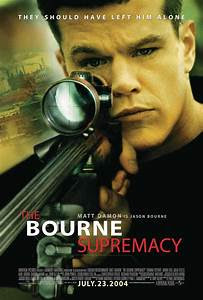
 The film version of The Bourne Supremacy was released stateside on July 23, 2004. Paul Greengrass directed the film, from a script by Tony Gilroy.

  Matt Damon reprised his role of Jason Bourne. Franka Potente reprised her role of Marie St. Jacques. Brian Cox reprised his role of Ward Abbott. Julia Stiles reprised her role of Nicolette "Nicky" Parsons. Gabriel Mann reprised his role of Danny Zorn. Joan Allen played Pamela Landy. Karl Urban played Kirill. Michelle Monaghan played Kim. Tom Gallop played Tom Cronin.