(hb; 2010; illustrations by Ian Falconer)
From the inside flap:
"If animals were more like us,
if mice kept pets and toads could cuss,
if dogs had wives and chipmunks dated,
sheep sat still and meditated,
then in the forest, field and dairy
you might find this bestiary,
read by storks, by rats and kitties,
skimmed by cows with milk-stained titties.
'I found this book to be most droll,'
might quip the bear, the owl, the mole.
Others, though, would be more coarse.
'Bull,' could say the pig and horse.
As to the scribe, they'd quote the hen:
'Trust me, he's no La Fontaine.' "
•
Review:
Grim morality-toned book that looks like a kid's book, but isn't.
Falconer's stunning illustrations amplify the effect of Sedaris's short, sharp 'animals with anthromorphized motives' stories, from the bleak "The Crow and the Lamb", "The Vigilant Rabbit" and "The Sick Rat and the Healthy Rat" (with their egregious, manipulative and self-righteous villains) to the comparatively gentle and sublime "The Parenting Storks" and "The Grieving Owl".
This book isn't for the faint of heart, but it should be read by as many people as possible. There's more than a bit of ourselves in these fickle, purblind, judgmental and pernicious animals, more than most of us would probably like to admit.
This is one of my favorite reads of late -- worth owning.
Showing posts with label favorite reads 2010. Show all posts
Showing posts with label favorite reads 2010. Show all posts
Saturday, November 27, 2010


Monday, September 20, 2010
Falling Angel by William Hjortsberg

(pb; 1978)
From the back cover
"Louis Cyphre had a fiendish smile and flaunted some bizarre fetishes. So what. The fat price Cyphre was paying for a routine missing-persons assignment convinced Harry Angel to shake off his customary shivers about Cyphre's weird ways.
"But Harry's pay turned to blood as each of his leads dissolved into a dizzying nightmare of black magic and gory murders. And the more he sought the terrifying shadow of the long lost Johnny Favorite, the closer he came to chasing his own."
Review
Set in 1959, Falling Angel is an original, über clever, supernaturally flavored private dick novel. It's tightly characterized and written, oozy and often bloody with neo-noir-esque shadows and characters who are cursed, but don't know it yet.
Falling Angel has one minor flaw. Hjortsberg, perhaps too clever for his own good, tips his hand a bit early on the final revelations of the book, at least for this (sometimes) sharp-eyed reader.
Despite this minor flaw, pulp and horror aficionados should check out this landmark crossover work. Followed by Angel's Inferno.
#
The resulting film, retitled Angel Heart, graced stateside screens on March 6, 1987.
Mickey Rourke played Harry Angel. Robert DeNiro played Louis Cyphre. Lisa Bonet played Evangeline Proudfoot.
Charlotte Rampling played Margaret Krusemark. Stocker Fontelieu played Ethan Krusemark. Brownie McGhee played Toots Sweet. Michael Higgins played Dr. Fowler. Charles Gordone played Spider Simpson.
Dann Florek played Herman Winesapp. Pruitt Taylor Vince played Det. Deimos. Eliot Keener played Det. Sterne.
Alan Parker scripted and directed the film.

Friday, September 17, 2010
Dexter is Delicious, by Jeff Lindsay
(hb; 2010: fifth book in the Dexter series)
From the inside flap:
"Dexter Morgan's happy homicidal life is undergoing some major changes. He's always lived by a single golden rule -- he kills only people who deserve it. But the Miami blood-spatter analyst has recently become a daddy -- to an eight-pound curiosity named Lily Anne -- and strangely, Dexter's dark urges seem to have left him. Is he ready to become an overprotective father? To pick up soft teddy bears instead of his trusty knife, duct tape, and fishing wire? What's a serial killer to do?
"Then Dexter is summoned to investigate the disappearance of an eighteen-year-old girl who seems to have been abducted by a bizarre group. . . who just may be vampires. . . and -- possibly cannibals. Nothing like the familiar hum of his day job to get Dexter's creative dark juices flowing again. Assisting his bull-in-a-china-shop detective sister, Deborah, Dex wades into an investigation that gets more disturbing by the moment. And to compound the complication of Dexter's ever-more-complicated life, a person from his past suddenly reappears. . . moving dangerously close to his home turf and threatening to destroy the one thing that has maintained Dexter's pretend human cover and kept him out of the electric chair: his new family."
Review:
Dexter takes his Dark Passenger -- or, as his step-son, Cody, calls it, his "Shadow Guy" -- on another pinball-ricochet ride of family craziness, wit, near-ruin and death (possibly his own).
Dexter is Delicious is another blast-through-it, funny, subversive take on American life from Lindsay, with an effective wraps-it-up-for-now, sequel-friendly finish.
Worth owning, this.
Followed by Double Dexter.
From the inside flap:
"Dexter Morgan's happy homicidal life is undergoing some major changes. He's always lived by a single golden rule -- he kills only people who deserve it. But the Miami blood-spatter analyst has recently become a daddy -- to an eight-pound curiosity named Lily Anne -- and strangely, Dexter's dark urges seem to have left him. Is he ready to become an overprotective father? To pick up soft teddy bears instead of his trusty knife, duct tape, and fishing wire? What's a serial killer to do?
"Then Dexter is summoned to investigate the disappearance of an eighteen-year-old girl who seems to have been abducted by a bizarre group. . . who just may be vampires. . . and -- possibly cannibals. Nothing like the familiar hum of his day job to get Dexter's creative dark juices flowing again. Assisting his bull-in-a-china-shop detective sister, Deborah, Dex wades into an investigation that gets more disturbing by the moment. And to compound the complication of Dexter's ever-more-complicated life, a person from his past suddenly reappears. . . moving dangerously close to his home turf and threatening to destroy the one thing that has maintained Dexter's pretend human cover and kept him out of the electric chair: his new family."
Review:
Dexter takes his Dark Passenger -- or, as his step-son, Cody, calls it, his "Shadow Guy" -- on another pinball-ricochet ride of family craziness, wit, near-ruin and death (possibly his own).
Dexter is Delicious is another blast-through-it, funny, subversive take on American life from Lindsay, with an effective wraps-it-up-for-now, sequel-friendly finish.
Worth owning, this.
Followed by Double Dexter.
Monday, September 13, 2010
Dog Blood, by David Moody
(hb; 2010: Book Two of the Hater trilogy)
From the inside flap:
"The world has been torn apart: split into two unequal parts by an unstoppable outburst of violence more brutal, far-reaching, and extreme than any previous conflict. Governments have fallen, communities have been destroyed, and families devastated. Everyone has been forced to take a side. Your past counts for nothing now -- the only choice you have left is how hard you fight.
"The terrified Unchanged masses cower in fear, holed up in vast, barely functioning refugee camps in major city centers. The war continues to rage all around them, with neither the military nor the Haters prepared to stop fighting until their enemy has been destroyed.
"Danny McCoyne isn't interested in the war. His only concern is finding his five-year old daughter, Ellis. McCoyne, however, hasn't realized the true importance of children in the new world order. Uninhibited by memories of how things used to be, children are strong, fast, and unstoppable. They are the true Haters.
"Every step McCoyne takes drags both him and Ellis deeper and deeper into this cruel and bloody war, a war that won't end until one side has completely eradicated the other."
Review:
Savage, unputdownable, refreshing and often disturbing take on the clichéd zombie genre. Like Hater before it, the raw force, nuanced writing and surprising characters of Dog Blood makes it a landmark work, and an exceptional follow-up to its prequel.
According an August 25, 2010 entry on Moody's website, Them Or Us, the third novel in the Hater trilogy, is scheduled for a Summer or Autumn 2011 release.
From the inside flap:
"The world has been torn apart: split into two unequal parts by an unstoppable outburst of violence more brutal, far-reaching, and extreme than any previous conflict. Governments have fallen, communities have been destroyed, and families devastated. Everyone has been forced to take a side. Your past counts for nothing now -- the only choice you have left is how hard you fight.
"The terrified Unchanged masses cower in fear, holed up in vast, barely functioning refugee camps in major city centers. The war continues to rage all around them, with neither the military nor the Haters prepared to stop fighting until their enemy has been destroyed.
"Danny McCoyne isn't interested in the war. His only concern is finding his five-year old daughter, Ellis. McCoyne, however, hasn't realized the true importance of children in the new world order. Uninhibited by memories of how things used to be, children are strong, fast, and unstoppable. They are the true Haters.
"Every step McCoyne takes drags both him and Ellis deeper and deeper into this cruel and bloody war, a war that won't end until one side has completely eradicated the other."
Review:
Savage, unputdownable, refreshing and often disturbing take on the clichéd zombie genre. Like Hater before it, the raw force, nuanced writing and surprising characters of Dog Blood makes it a landmark work, and an exceptional follow-up to its prequel.
According an August 25, 2010 entry on Moody's website, Them Or Us, the third novel in the Hater trilogy, is scheduled for a Summer or Autumn 2011 release.
Wednesday, September 08, 2010
Packing For Mars: The Curious Science of Life in the Void, by Mary Roach

(hb; 2010: science/non-fiction)
From the inside flap:
"Space is a world devoid of the things we need to live and thrive: air, gravity, hot showers, fresh produce, privacy, beer. Space exploration is in some ways an exploration of what it means to be human. How much can a person give up? How much weirdness can they take? What happens to you when you can't walk for a year? Have sex? Smell flowers? What happens if you vomit in your helmet during a spacewalk? Is it possible for the human body to survive a bailout from space? To answer these questions, space agencies set up all manner of quizzical and startling bizarre space simulations. As Mary Roach discovers, it's possible to preview space without ever leaving Earth. From the Space Shuttle training toilet to a crash test of NASA's new space capsule (cadaver filling in for astronaut), Roach takes us on a surreally entertaining trip into the science of life in space and space on Earth."
Review:
Another entertaining, informative, laugh-out-loud funny, sometimes icky, and snarky read from Roach.
Own this, already.
Tuesday, August 24, 2010
Vampire$, by John Steakley
(pb; 1990)
From the back cover:
"Suppose there really were vampires.
"Dark. Stalking. Destroying.
"They'd have to be killed, wouldn't they?
"Of course they would.
"But what kind of fools would try to make a living at it?"
Review:
Vampire$ is a grim, snarling, tightly-written gem of a back-to-basics horror novel that manages, in its simply stated and wild-violent way, to be a landmark work in bloodsucker fiction. Emotional, tender and brutal as a war novel, with complex, desperate characters, this.
•
The film version was released stateside on October 30, 1998.
James Woods played Jack Crow. Daniel Baldwin played Anthony Montoya. Sheryl Lee played Katrina. Thomas Ian Griffith played Jan Valek. Maximilian Schell played Cardinal Alba. Mark Boone Junior played Catlin. Frank Darabont played "Man With Buick". An uncredited Lex Lang narrated the film.
John Carpenter directed the film, from a screenplay by Don Jakoby.
From the back cover:
"Suppose there really were vampires.
"Dark. Stalking. Destroying.
"They'd have to be killed, wouldn't they?
"Of course they would.
"But what kind of fools would try to make a living at it?"
Review:
Vampire$ is a grim, snarling, tightly-written gem of a back-to-basics horror novel that manages, in its simply stated and wild-violent way, to be a landmark work in bloodsucker fiction. Emotional, tender and brutal as a war novel, with complex, desperate characters, this.
•
The film version was released stateside on October 30, 1998.
James Woods played Jack Crow. Daniel Baldwin played Anthony Montoya. Sheryl Lee played Katrina. Thomas Ian Griffith played Jan Valek. Maximilian Schell played Cardinal Alba. Mark Boone Junior played Catlin. Frank Darabont played "Man With Buick". An uncredited Lex Lang narrated the film.
John Carpenter directed the film, from a screenplay by Don Jakoby.
Friday, July 16, 2010
Zebra by Clark Howard

From the inside flap:
". . .[Zebra] is the true account of five Black men who held a city in a 179-day grip of terror. Provoked and guided by their leaders, these men randomly selected for kidnap, rape, robbery, mutilation and murder, 23 victims from the streets of San Francisco -- any street, any time. Calling themselves Death Angels, they set a goal: to sacrifice nine 'blue-eyed devils' each, for their God, Allah.
"Using every avenue open to the research journalist (and some known only to the author himself) -- records, reports, witnesses, surviving victims, relations even the convicted men themselves, and the informer who risked a nightmare death to stop the killings -- Howard has probed as deeply into the minds of murderers as anyone is ever likely to go. He shows us frenzied men, killing in the name of a religion that is teaching them white hatred. And he takes us into the insecurities about color, their desire for respect, their burning ambition to rise above their status. He shows us killers as we have never seen them: caught in a clash of right and wrong, black and white, life and death. . ."
Review:
Subtitled "The true account of the 179 days of terror in San Francisco", this is a riveting chronicle of five Black Muslim extremists who killed fifteen random people and attacked eight others in the Bay Area between the latter part of 1973 and early part of 1974. Their luck in eluding capture -- on par with that of the Zodiac killer -- was incredible, considering the enormity of their criminal ignorance: incredible but horifically true.
Damn near impossible to put down, this. Worth owning, too.
[Interesting side-note: the crimes, then-Chief of Police Donald M. Scott said in a 1973 press release, were not dubbed 'the Zebra killings' because of the black-on-white violence of the attacks. They were called this, Scott told the press, "[because] the Z-for-Zebra channel happened to be the only frequency available for exclusive use." (p. 241)]
Monday, July 12, 2010
Walkers by Graham Masterton

From the back cover:
"It didn't take long for Jack Reed to decide to convert the huge gothic building in the woods into an idyllic, up-market country club.
"But behind the ornately carved walls of The Oaks lurks a past that was anything but idyllic. Sixty years ago the house was an asylum, home to crazed psychopaths -- all of whom disappeared one night, never to be seen again.
"Now the empty rooms echo the soundless screaming of the madmen trapped inside the brick and plaster, walking endlessly through the maze-like mansion. And now Jack's son, dragged into the hellish prison of the walls, is held a screaming hostage by Quintus Miller, leader of the insane.
"Quintus took the killers into the walls. Now, he insists, Jack Reed will set them free -- or his son will die."
Review:
Landmark work that takes its subject way beyond its specific-source subgenre (spookhouse fiction) -- Masterton keeps it creepy (and f**ked-up funny in some parts), continually ratcheting up the terror factor and the unexpected plot and character turns. More than the usual "ooooh, scary ghosts" horror fare, Masterton not only manages to raise the genre bar, but morphs it into something greater, while thematically linking it to his five-book The Manitou series: an added perk for Masterton's "regular" readers.
Worth owning, this.
Saturday, June 12, 2010
The Blackwater serial novels by Michael McDowell

1.) Blackwater: I - The Flood
From the back cover
"Elinor Dammert was rescued from her room in the flood-isolated hotel. What strange mission brought her there? How did she survive her isolation? Why was she in the Alabama town of Perdido that Easter morning in 1919?
"These questions would never be answered because larger and even more terrifying ones would be asked. She soon would become a strange presence in the wealthy Caskey family and their town. Horrors, virtually unspeakable and nearly indescribable, follow."
2.) Blackwater: II - The Levee
From the back cover
"Elinor Dammert abandoned her first-born child in a bargain with Mary-Love Caskey of Perdido, Alabama, and set in motion a series of strange familial entanglements. Her goals: power, money, her way.
"In her way, she would begin to suck power from the weaknesses of the family she had entered through marriage. Her power would be felt again and again even if it meant murder -- or a horrifying ancient ritual death.
"Elinor Dammer must win."
3.) Blackwater: III - The House
From the back cover
"The Depression came hard to most people in Perdido, Alabama, but the town's first family weathered the storm under the guidance of the indomitable Mary-Love Caskey and the increasing influence of her daughter-in-law, Elinor.
"Strange and malevolent were the ways of Elinor to those who stood in her way. Those she loved would prosper. Those she disliked would die hideously. No court could call it murder because her manner was not human."
4.) Blackwater: IV - The War
From the back cover
"Wartime in Perdido jolted the sleepy little Alabama town as new people entered the community. Outsiders would invade the comfort of the wealthy Caskeys and take their daughters.
"This, though, was part of the master plan of Elinor Caskey, who would see the family flourish amidst the destruction and death she administered in a fashion more awesome than the war itself."
5.) Blackwater: V - The Fortune
From the back cover
"Under Elinor's guidance, the Caskey family prospered after the war, not knowing that a dark infernal force was growing in their midst. And Frances, Elinor's favorite daughter, never understood her yearning for the Perdido River. . . until the day her babies were born.
"Elinor presided over the secret birth, the triumph of her life. And the blood red water of the Perdido continued to claim its own -- both humans and demons -- some in grisly death, some in exquisite surrender."
6.) Blackwater: VI - Rain
From the back cover
"As the Caskey family and their town of Perdido rode the crest of prosperity in the '60s, matriarch Elinor had good reason to be proud of her domain. But slowly, silently, unimaginable horrors were creeping into their midst.
"At the height of revelry, at the peak of chaos, in the fearful silence of blackest night, preternatural horror pounced upon the Caskeys. But still Elinor reigned, until her solemn vow of death came true -- in the final hour."
Review
Solid, character-rich narrative, spanning six decades, about the wealthy Caskey family, and a strange woman (Elinor Dammert) who marries into it. Over the course of six decades, through her quiet, smart and supernatural manipulations, Elinor furthers the family's social and financial positions.
The spookiness and horror, aside from a few gory brutal and brief instances, is more prevalent in the family's circumstances and increased wealth, and in the occasional disappearances of Perdido citizens -- often after the unreported sightings of a startling river monster.
Sublime, genre-mixed, hard-to-put-down original serial novel series, this. The history- and character-punctuated horrors mount well, culminating in a satisfactory story- and mood-consistent denouement that dovetails not-so-nicely (in a horrific way) with the beginning of the story.
Own this.
Friday, March 26, 2010
The Getaway Man, by Andrew Vachss
(pb; 2003)
From the back cover:
"Eddie starts stealing cars long before he's old enough to get a license, driven by a force so compelling that he never questions, just obeys. After a series of false starts, interrupted by stays in juvenile institutions and a state prison term, Eddie's skills and loyalty attract the attention of J.C., a near-legendary hijacker. Eddie becomes the driver for J.C.'s ultra-professional crew. J.C., the master planner, is finally ready to pull off that one huge job every con dreams of. . the Retirement Score. But some roads have twists even a professional getaway man can't foresee. . ."
Review:
Noir doesn't get much leaner than this. A present-day homage to the noir of the Forties and Fifties, Vachss's prose is stripped down, its twists explosive (and often unexpected), and his characters multi-layered and fascinating.
A must-read for any crime fiction aficionado: this is one of the best noir novels I've read in a while.
From the back cover:
"Eddie starts stealing cars long before he's old enough to get a license, driven by a force so compelling that he never questions, just obeys. After a series of false starts, interrupted by stays in juvenile institutions and a state prison term, Eddie's skills and loyalty attract the attention of J.C., a near-legendary hijacker. Eddie becomes the driver for J.C.'s ultra-professional crew. J.C., the master planner, is finally ready to pull off that one huge job every con dreams of. . the Retirement Score. But some roads have twists even a professional getaway man can't foresee. . ."
Review:
Noir doesn't get much leaner than this. A present-day homage to the noir of the Forties and Fifties, Vachss's prose is stripped down, its twists explosive (and often unexpected), and his characters multi-layered and fascinating.
A must-read for any crime fiction aficionado: this is one of the best noir novels I've read in a while.
Saturday, March 20, 2010
Asia Shock: Horror & Dark Cinema from Japan, Korea, Hong Kong and Thailand, by Patrick Galloway
(hb; 2006: non-fiction. Illustrations by Greg Lofrano)
From the back cover:
"Asian Extreme cinema is hot, and this book celebrates all its gory glory. Patrick Galloway, who last looked at samurai films in Stray Dogs & Lone Wolves: The Samurai Handbook, now takes on Asian masters of suspense, exploitation, the supernatural, and bone-chilling, blood-curdling horror. This critical guide contains over 50 reviews of fans' and critics' favorites ranging from classics like [Nobuo] Nakagawa's The Ghost of Yotsuya to contemporary cutting-edge films by Takashi Miike and Park Chan-wook. Included are viewing tips, cultural backgrounds, and genre overviews."
Review:
This is an indispensable guide to Asian cinema. Whether you're unfamiliar with the cultures and films Galloway analyzes and appreciates, or you're somewhat familiar with them (like I am), there's something for any dark cineaste here.
Knowledgeable, critical (when necessary) and enthusiastic about its subject matter, Asia Shock is one of the best books I've read about these types of films.
Own this, if you have a bent for splatterific, vicious and/or lurid films.
From the back cover:
"Asian Extreme cinema is hot, and this book celebrates all its gory glory. Patrick Galloway, who last looked at samurai films in Stray Dogs & Lone Wolves: The Samurai Handbook, now takes on Asian masters of suspense, exploitation, the supernatural, and bone-chilling, blood-curdling horror. This critical guide contains over 50 reviews of fans' and critics' favorites ranging from classics like [Nobuo] Nakagawa's The Ghost of Yotsuya to contemporary cutting-edge films by Takashi Miike and Park Chan-wook. Included are viewing tips, cultural backgrounds, and genre overviews."
Review:
This is an indispensable guide to Asian cinema. Whether you're unfamiliar with the cultures and films Galloway analyzes and appreciates, or you're somewhat familiar with them (like I am), there's something for any dark cineaste here.
Knowledgeable, critical (when necessary) and enthusiastic about its subject matter, Asia Shock is one of the best books I've read about these types of films.
Own this, if you have a bent for splatterific, vicious and/or lurid films.
Friday, March 05, 2010
The Laughing Policeman, by Maj Sjöwall & Per Wahlöö
(pb; 1970: fourth book in the Martin Beck Police Mysteries. Translated from the Swedish by Alan Blair.)
From the back cover:
"On a bitter cold and rainy night, nine bus riders are gunned down by an unknown assassin in Stockholm. It seems a random crime, and the press, anxious for any explanation, dubs him a madman. But Superintendent Martin Beck of the Homicide Squad suspects otherwise: this apparently motiveless killer has managed to target one of Beck's best detectives -- and he, surely, wouldn't have been on that lethal bus without a reason."
Review:
Plot- and writing-taut, unpredictable and thrilling as its series predecessors, The Laughing Policeman is my favorite Martin Beck Mystery thus far, largely because of the strangeness of the crime, and an equally-strange mystery: why was one of Beck's detectives -- who normally didn't take public transport -- on that particular bus?
Worth owning, this.
Followed by The Fire Engine That Disappeared.
•
The Laughing Policeman, the film, was released stateside on December 20, 1973.
Walter Matthau played Sgt. Jake Martin SFPD. Bruce Dern played Insp. Leo Larsen SFPD. Louis Gossett Jr., billed as Lou Gossett, played Insp. James Larrimore. Anthony Zerbe played Lt. Nat Steiner SFPD. Val Avery played Insp. John Pappas SFPD.
Cathy Lee Crosby played Kay Butler. Joanna Cassidy played "Monica, Beth's Roommate". Paul Koslo played "Duane Haygood, Drug Pusher".
Stuart Rosenberg directed the film, from a script by Thomas Rickman.
From the back cover:
"On a bitter cold and rainy night, nine bus riders are gunned down by an unknown assassin in Stockholm. It seems a random crime, and the press, anxious for any explanation, dubs him a madman. But Superintendent Martin Beck of the Homicide Squad suspects otherwise: this apparently motiveless killer has managed to target one of Beck's best detectives -- and he, surely, wouldn't have been on that lethal bus without a reason."
Review:
Plot- and writing-taut, unpredictable and thrilling as its series predecessors, The Laughing Policeman is my favorite Martin Beck Mystery thus far, largely because of the strangeness of the crime, and an equally-strange mystery: why was one of Beck's detectives -- who normally didn't take public transport -- on that particular bus?
Worth owning, this.
Followed by The Fire Engine That Disappeared.
•
The Laughing Policeman, the film, was released stateside on December 20, 1973.
Walter Matthau played Sgt. Jake Martin SFPD. Bruce Dern played Insp. Leo Larsen SFPD. Louis Gossett Jr., billed as Lou Gossett, played Insp. James Larrimore. Anthony Zerbe played Lt. Nat Steiner SFPD. Val Avery played Insp. John Pappas SFPD.
Cathy Lee Crosby played Kay Butler. Joanna Cassidy played "Monica, Beth's Roommate". Paul Koslo played "Duane Haygood, Drug Pusher".
Stuart Rosenberg directed the film, from a script by Thomas Rickman.
Tuesday, March 02, 2010
The Wolfen by Whitley Strieber

From the inside flap
"The Wolfen are here, and they have finally been discovered in the midst of men, because they have made a mistake: the unbelievably savage killing of two New York City policemen.
"And so they are hunted: by Detective George Wilson and his partner, Detective Beck Neff, who hate and love one another with a strange passion.
"And when the Wolfen realize that their existence is known by these two 'dangerous ones,' then the Wolfen begin to hunt them in return. .."
Review
This is one of the best werewolf novels I've read.
Near-impossible to set down, loaded with interesting characters and action/gore sequences, and imbued with a distinctive slant on the werewolf legend, this is a high water mark in the horror/fur n' fang genres.
Worth owning, this.
#
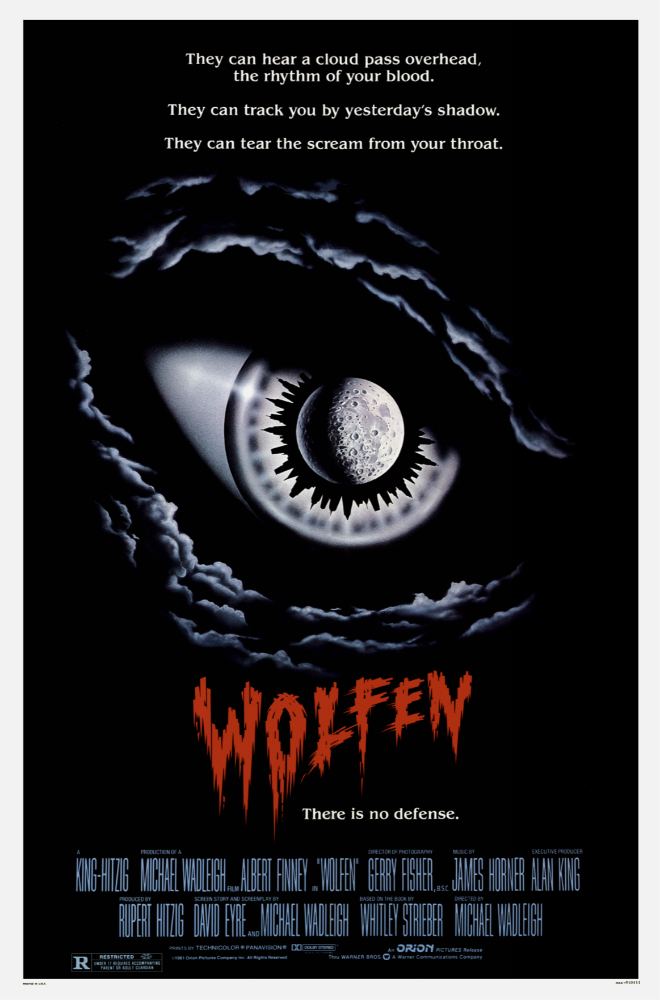
The film version, Wolfen, was released stateside on July 24, 1981.
Albert Finney played Dewey Wilson (cinematic stand-in for George Wilson). Diane Venora played Rebecca Neff. Edward James Olmos played Eddie Holt. Gregory Hines played Whittington. Tom Noonan played Ferguson.
Dick O'Neill played Warren. James Tolkan played Baldy. Peter Michael Goetz played Ross.
An uncredited Tom Waits played "Drunken Bar Owner".
Michael Wadleigh directed and co-scripted the film; his co-writers on this project were David Eyre and an uncredited Eric Roth.
Tuesday, January 12, 2010
How To Read/Write A Dirty Story, by Susie Bright
(pb; 2001: non-fiction)
From the back cover:
"Susie Bright, the bestselling editor and founder of The Best American Erotica series and the first Herotica anthologies, has finally written the complete guide for people who like to read, write, publish, and think about sex.
". . . Bright offers the dream How-To book -- not to mention a How-To-Dream book -- for the erotic literati:
"For Erotic Writers:
"What is Your Sexual Story?
"Creating Sexual Characters
"Steamy Plots
"How to Mix Sex with Other Genres
"Up-to-Date Resources for Erotic Authors
"For Erotic Readers:
"Is This a Stroke Book or Is This Art?
"The Erotic Reader's Bill of Rights
"The 'Good Parts'
"Susie's Favorite Erotic Reference Library
"For Erotic Thinkers:
"Is Writing Sex Better than Having Sex?
"The Similarities Between Erotica and Pornography
"Sex and Violence
"Erotica Burn-out
"For Erotic Publishers:
"A Devil's Argument Against Publishing
"Finding the Perfect Editor
"Money Money Money
"Big-Time, Small Press, and Internet Publishing
"Can You Be an Artist and a Salesman?
"Fan Clubs, Book Tours, and Book Reviews
"With candor and humor, Bright tells her own explicit adventures in erotic publishing from the creative inspiration to the nitty-gritty economics. She offers provocative exercises for writers and readers alike to hone their writing and critical skills, and opens up the whole treasure chest of erotic literature and history. Here's a guide that will teach you not only how to 'write a dirty story,' but also to recognize the most powerful and insightful places in the erotica experience."
Review:
How To... is a practical, informative and supportive guide for any fiction writer who may find themselves (or their characters) confronting the issue of sex. A well-written, plot-centric sex scene furthers the narrative, and reveals (non-)emotional elements of the characters in question; it's not just thrown in to titillate: so says Bright early on, a point she maintains throughout How To....
In straightforward, warm language, Bright tells readers how to start and maintain a writing career, no matter what genre(s) you write for, fiction or non-fiction, erotica or mainstream pop fiction, et cetera. It covers how to become/stay sane and successful while navigating the wild and unexpected script-flips life throws at you: publishing and marketing joys, follies and failures; critics, many of whom won't (intentionally or unintentionally) "get" your work, no matter what you write; financial woes and boosts. . . You know, life!
This is one of the best 'how to be a writer' books I've read.
If you're an open-minded and mature writer or artist (i.e., you acknowledge that diversity and sex is healthy and nothing to be ashamed of), this may be an excellent resource for you. (Experienced writers/artists may get a lot of out How To..., as well -- a creative life is one lined with inevitable, particular blues, and we all need suportive reminders, from time to time, about how to get back on our feet.)
Worth owning, and re-reading, this.
From the back cover:
"Susie Bright, the bestselling editor and founder of The Best American Erotica series and the first Herotica anthologies, has finally written the complete guide for people who like to read, write, publish, and think about sex.
". . . Bright offers the dream How-To book -- not to mention a How-To-Dream book -- for the erotic literati:
"For Erotic Writers:
"What is Your Sexual Story?
"Creating Sexual Characters
"Steamy Plots
"How to Mix Sex with Other Genres
"Up-to-Date Resources for Erotic Authors
"For Erotic Readers:
"Is This a Stroke Book or Is This Art?
"The Erotic Reader's Bill of Rights
"The 'Good Parts'
"Susie's Favorite Erotic Reference Library
"For Erotic Thinkers:
"Is Writing Sex Better than Having Sex?
"The Similarities Between Erotica and Pornography
"Sex and Violence
"Erotica Burn-out
"For Erotic Publishers:
"A Devil's Argument Against Publishing
"Finding the Perfect Editor
"Money Money Money
"Big-Time, Small Press, and Internet Publishing
"Can You Be an Artist and a Salesman?
"Fan Clubs, Book Tours, and Book Reviews
"With candor and humor, Bright tells her own explicit adventures in erotic publishing from the creative inspiration to the nitty-gritty economics. She offers provocative exercises for writers and readers alike to hone their writing and critical skills, and opens up the whole treasure chest of erotic literature and history. Here's a guide that will teach you not only how to 'write a dirty story,' but also to recognize the most powerful and insightful places in the erotica experience."
Review:
How To... is a practical, informative and supportive guide for any fiction writer who may find themselves (or their characters) confronting the issue of sex. A well-written, plot-centric sex scene furthers the narrative, and reveals (non-)emotional elements of the characters in question; it's not just thrown in to titillate: so says Bright early on, a point she maintains throughout How To....
In straightforward, warm language, Bright tells readers how to start and maintain a writing career, no matter what genre(s) you write for, fiction or non-fiction, erotica or mainstream pop fiction, et cetera. It covers how to become/stay sane and successful while navigating the wild and unexpected script-flips life throws at you: publishing and marketing joys, follies and failures; critics, many of whom won't (intentionally or unintentionally) "get" your work, no matter what you write; financial woes and boosts. . . You know, life!
This is one of the best 'how to be a writer' books I've read.
If you're an open-minded and mature writer or artist (i.e., you acknowledge that diversity and sex is healthy and nothing to be ashamed of), this may be an excellent resource for you. (Experienced writers/artists may get a lot of out How To..., as well -- a creative life is one lined with inevitable, particular blues, and we all need suportive reminders, from time to time, about how to get back on our feet.)
Worth owning, and re-reading, this.
Subscribe to:
Posts (Atom)