Showing posts with label zombie works. Show all posts

Monday, January 29, 2024

Escape from the Living Dead by John Russo


(pb; 2013: sequel to the 1978 book version of John Russo’s Return of the Living Dead. Third book in Russo’s Living Dead series.)


From the back cover

“In an isolated roadside diner, a desperate group of strangers barricade themselves against a ravenous horde of undead customers who crave something more than the early bird special. They want flesh. Human flesh. With a side order of brains and stomach-turning terror.”


Review

Escape, set sixteen years after the events of Night of the Living Dead (1968) and ten years after Return of the Living Dead (published in 1978), has the same virtues and drawbacks (for some readers) as Russo’s two previous Living Dead books, with a few series-fresh and world-expansive ideas thrown into the mix (e.g., a scientist, Dr. Harold Melrose, who’s infected with zombifying virus but doesn’t “turn”).

If you like blunt action with little nuance, short-lived characters whose pasts are effectively sketched out (to keep the action going at rapid clip), and villains who are repulsive in their outlooks and violence, Escape might be your pulpy, putrescent and gory kick. If I have any criticisms of Russo’s writing, it’s usually this: he makes philosophical statements that take me out of the story unnecessarily—these truths and musings could easily be woven seamlessly into the story, within the characters’ dialogue, actions, and situations themselves; also, some of his characters’ dialogues are stilted, providing awkwardly stated story information and information about their pasts (while talking to people who’ve known them awhile and therefore should already know them).

These minor nits aside, Escape, like Russo’s other works, is a choppy-edit, gory, grim, violent and character-sketched tale, one worth reading if you can embrace the above-stated qualities of his writing, and don’t mind a bit of bleak-humored misanthropy.

Tuesday, October 03, 2023

Return of the Living Dead by John Russo


(pb; 1978: sequel to Night of the Living Dead; prequel to Escape from the Living Dead)


Review

This book should not to be confused with the novelization of the 1985 horror comedy The Return of the Living Dead, for which Russo co-wrote the original screenplay—which was noticeably rewritten as a punk comedy later. John Russo also wrote the movie adaptation of the 1985 film, which is NOT this book.

Russo, co-screenwriter of the 1968 film Night of the Living Dead and its 1974 novel counterpart of the same name, keeps it raw, gory, and violent as the original film/novel, with posse-leading Sheriff Conan McClellan (who famously said “They’re dead. . . they’re all messed up” in Night) investigating what appears to be a fresh zombie outbreak in his county—it’s been ten years since the original undead attacks, something that haunts McClellan, who’s reluctant to publicly acknowledge this new zombie uprising. Still, he’s leading a new posse of thirty or forty men to put down this new spate of terror.

Meanwhile, taciturn farmer Bert Miller and his three daughters (Sue Ellen, Ann, and Karen—the latter of whom is pregnant) are four of the many people who also remember that pivotal event ten years ago and put spikes in the heads of the dead. When he lets three lawmen with two suspects in tow into their house, it might not be the best decision he makes.

As with his other works, Russo’s characters’ histories, motivations and personalities are sketched out throughout the book—thereby keeping their characters relatable, without cluttering the flow of the stark, action-oriented pacing of his storyline and, at the same time, maintaining Return’s palpable tension, effective gore, and stark, disturbing nothing and nobody is safe vibe. This is not a read for sensitive readers who need to know what the characters’ agendas and politics are or need their characters’ histories/emotions spelled out for them.

Was it the crashed Venus probe—also mentioned in passing in Night—or a weird energizing cancer spreading among the dead? It doesn’t matter for those in this tale; what matters is stopping the new uprising, something McClellan and, elsewhere, police officers Carl Martinelli and Dave Benton are keen on.  

Return, like Night, is about fear, violence, misunderstandings, and dark humanity, with touches of grim humor and an unsettling finish spicing up this blunt, sometimes horrific action read.

Monday, June 05, 2023

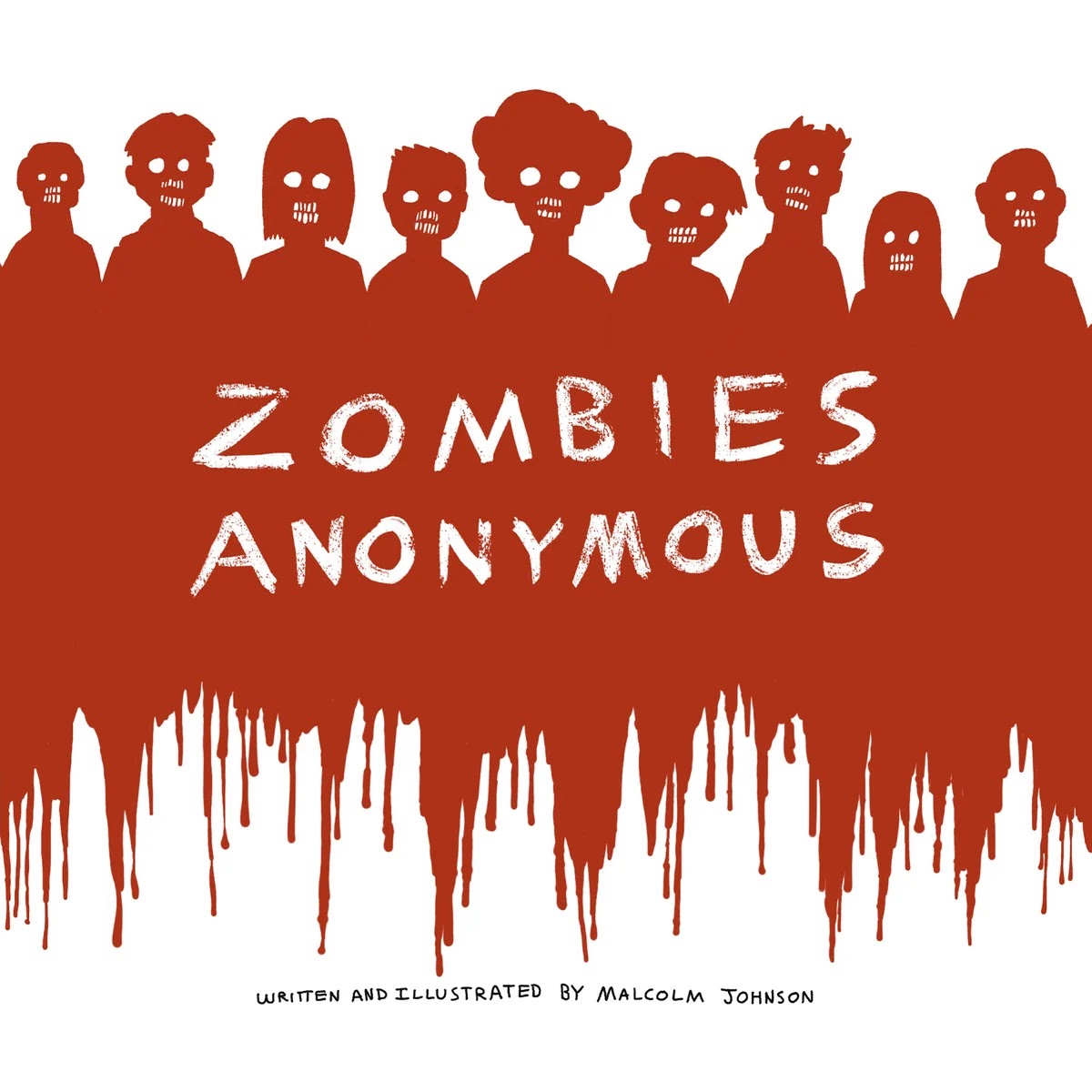
Zombies Anonymous written and illustrated by Malcolm Johnson


(pb; 2021:  graphic novel)

From the back cover

“Witness the zombie apocalypse like never before, told never before, told through the point of view of the undead in recovery.”


Review

Written and illustrated by Johnson, this fast-moving ten-minute and short read is narrated by various cognizant zombies (“biters”) in an “incident” (read: death/zombification) recovery group whose stories are shown while their recovery group session is not.

The biters talk about how many days it’s been since they’ve bitten. Their voice-overs are sprinkled with quoted lyrics (e.g., Leonard Cohen, The Mars Volta), and the illustrations—basic, spare in relative detail, more effective for being so—make effective use of red (as well as black and white) and dark, sometimes red-splash humor.

Anonymous, an entertaining undead-themed, quick-read graphic novel with a fun wrinkle placed within familiar storylines, is worth your time.

Tuesday, February 07, 2023

George A. Romero's Dawn of the Dead: Dissecting the Dead by various authors


(hb; 2020: nonfiction/essay collection – the 156-page book is included in Second Sight’s seven-disc Dawn of the Dead Blu-Ray/CD set)


From the back cover

“George A. Romero’s Dawn of the Dead has long been considered one of the high points of the zombie genre. Like its predecessor, Night of the Living Dead [1968], it blends extreme horror with broad, social commentary. Much has been written about Dawn of the Dead as a critique of consumerist society. However, as this collection of contemporary writing demonstrates, it much more than that. Here, leading voices from both genre film publications and academia bring a diverse range of new perspectives to Dawn of the Dead. In addition to fresh takes on the gender, race and class aspects of the film, there are also essays which explore the Gothic roots of Dawn of the Dead, its rocky reception in cinemas and home video in the UK and how it spawned an entire sub-genre in Italian exploitation cinema. . .”


Review

If you’re a big fan of Romero’s Dead series and/or the zombie genre in general, this is an overall interesting read. Not all the essays thrilled me, but for the most part they were interesting, and lent themselves to a more intriguing, deeper understanding of Dawn, creation, design, and influence-wise. Standout essays, at least for this reader, include:

Kat Ellinger’s “Romero’s New Gothic,” Jon Towlson’s “Superschlock!,” Martin Conterio’s “Combat Shock: Reflections on Vietnam and the War Movie Genre in Dawn of the Dead,” Daniel Bird’s “A Form of Punk: The Production and Distribution of Dawn of the Dead” and Jim Cironella, from his essay “Needle-Drop Nightmares.” Worth owning, this.


Wednesday, December 21, 2022

Dawn of the Dead by George A. Romero and Susanna Sparrow

(pb; 1979, republished 2020**)

From the back cover

“The world is being devastated by zombies. No one knows how far they have spread, or how to stop them. And as the living fight to save themselves, society collapses.

“Four people escape the chaos of downtown Philadelphia and find shelter in a shopping mall. But as the survivors exhaust their greed and the undead scrape at the doors, the refuge becomes a prison.

“And soon there will be nowhere left to hide.”


Review

Romero and Sparrow’s movie tie-in novelization of Romero’s 1978 landmark undead film is intense, immediately immersive, splatterific (at points), action-punctuated and character expansive (when compared to the film), a worthwhile companion work to the film. There isn’t a lot that’s different from its cinematic source-work (that I remember), but it’s a fun, fast and slickly written (and slightly icky) read, one worth seeking out.

[**republished/included in Second Sight’s 2020 seven-disc Blu-Ray Dawn of the Dead set]


Monday, March 23, 2020

Night of the Living Dead by John Russo

(pb; 1974: movie tie-in novel, based on John Russo and George A. Romero’s screenplay. Prequel to Return of the Living Dead and Escape from the Living Dead, also by John Russo.)

From the back cover

“They are coming, rising rotten from their graves, filling the night with a furious howl, and staining the earth bloody red. . .

“They are growing, their powers are swelling, from feasting on flesh and gnawing on bone, now they are drunk on the sweet taste of blood. . .

“Now they are here, and they march to the rhythm of death. Now they will crash down the gates, take all that is theirs, and wipe the blood from their lips. . .”


Review

Night is an excellent, stripped-to-the-bone undead (as in: zombie, a word that’s not mentioned in Night) novel. Even if you’ve seen the original 1968 film like many people, this is a taut, chilling and burn-through book, with enough gore to satisfy many viscera-appreciative readers, but not so much it distracts from the deftly sketched characters and urgent happenings within the story. Many of the characters, e.g. Ben, are given more backstories than they are in the film, and there are at least two additional scenes that add to said backstories and further the minor differences between Night‘s book and original film version.

The book likely won’t alter anyone’s outlook on either book or the film versions, along with their sequels and offshoots, but Russo’s Night is a gripping, lean, no-bulls**t and short companion piece to the original film.

If you are a fan of Night like I am, this is worth owning for a quick-thrill, iconic, hour-or-so read, and an acknowledgment of what a milestone the original film is: it completely altered how filmmakers and viewers saw the zombie genre─a media-quaking switch from voodoo-based undead to modern-day-neuroses undead.

#

There are too many film versions─remakes, sequels, spin-offs, rip-offs and the occasional worthwhile homages─to list here. Suffice to say, the original film, on which this book is based, was released stateside on October 4, 1968. George A. Romero, who co-wrote the screenplay, directed the film.


Wednesday, July 18, 2018

Essential Marvel: Tales of the Zombie Vol. 1 by various artists and writers


(pb; 1973─1975, 2006: graphic novel. Collects Dracula Lives #1─2 and Tales of the Zombie #1─10.)


From the back cover

“He lives! He strikes! No grave can hold him! Nothing can stop the man without a soul! Marked for human sacrifice by voodoo practitioners, Simon Garth was instead reanimated by mystical means ─ to be controlled by whoever holds the fabled Amulet of Damballah. And so begins the Tales of the Zombie! Terrors criminal, corporate and just plain creepy are reprinted here for the first time in more than a quarter-century! His stare’s the only thing that’s empty about the adventures of Simon Garth through mad science and madder magic!”


Review

The Tales magazine was a mix of 1970s atmospheric, pulpy voodoo artwork and stories (their themes often rooted in revenge, greed, lust and redemption) and informative articles about the voodoo religion, and films and books related to the subject─e.g., White Zombie, 1932, Ian Fleming’s 1954 James Bond novel Live and Let Die (which resulted in the 1973 movie) and George A. Romero’s 1968 iconic Night of the Living Dead.

Tales also has a recurring, titular character, also called Simon Garth, whose often-violent and troubling journey through unlife is recounted in at least one piece per collected issue. Garth is a sympathetic and subconsciously troubled character: his comic book actions─reprehensible or  kind─are mandated by his ever-changing masters (who hold the Amulet of Damballah, which control Garth).

Brother Voodoo’s loa-based heroics earn him recurring comic book status, as well. He, like Garth, also has sometimes uneven-in-quality adventures.

Overall, this is a fun, well-drawn and-inked (and short-lived) series. Some of Tale‘s articles and comic book storylines are thrilling, others are not. If you are into 1970s Marvel monster comics or  pulpy voodoun works, there is a good chance you will enjoy Tales. If you are not, but curious, borrow this from your local library─if it has it─or pick it up for an especially low price.


Tuesday, February 05, 2013

Coming Together: Hungry for Love, edited by Sommer Marsden

(pb; 2012: erotica / zombie anthology.  Foreword by Thomas Roche)


From the back cover:

"Why should the zombie apocalypse be the time to think about romance?  Like flesh for zombies, romance is the stuff of life for the living.  We shamble through life searching desperately for it, and nothing but love fills our need.

"In the pages of Hungry for Love, people find each other and love each other in a world of contagion, consumption and consumerism gone mad.

"Coming Together is about giving. . . and about sex (a powerful combination in any venue).  Each book in the series benefits a different charity.  Join us in doing good while being bad, and celebrate the diversity of life!"


Overall review:

Marsden has fashioned a solid, diverse collection of zombies-and-sex tales.  

A few of the stories didn't grab me - two ran too long (Kiki Howell's "Zombie Factory" and t'Sade's "Love Never Dies") and one of the stories (Erzabet Bishop's "Dark Hunger") was too predictable.

Even these flawed pieces had something to recommend them, as rough-write works - they merely needed to be whittled down slightly, or the author could have thrown an unfamiliar mini-twist into her shambling lust mix, to help distinguish it from other seen-this-before stories.

Hungry for Love is worth owning - for its charitable aims, and its published delivery.


Standout stories:

1.)  "My Name is Brighton" - Alana Noël Voth:  A date rape victim-turned-zombie seeks out one of the men (Paul) who used her - without being aware that he had done so.

More horror story than plot-lite sex work, this excellent, sympathetic and character-veracious tale is one of the best stories in this anthology.


2.)   "Meat" - Bobby Diabolus:  A bite-infected man goes through various stages of evolving desire, while looking for his raw, sexy ex-lover (Honey).

"Meat" is an interesting story that ably balances the emotional and carnal aspects of its lead character, without tipping into unintentional pornoriffic parody, emotive abstraction or zombie clichés.

This original, first person-POV tale vaguely echoes David Cronenberg's "Venereal Horror" films (e.g., Rabid, 1977;  The Brood, 1979; Videodrome, 1983; The Fly, 1986 remake; eXistenZ, 1999).


3.)  "Annie Morgan" - Armand Rosamilia:  Especially good piece about a mercurial, promiscuous woman confronting something more potent than undead attackers.


4.)   "Queer Zombie Disco" - Kirsty Logan:  Offbeat tune-based horror sex tale.


5.)   "Screen Siren" - Annabeth Leong:  Hollywood-skewering, imaginative piece about a Z-grade movie director (Sam) and an undead, sentient actress.

This is one of the best entries in this collection.


Other stories:

"You Make a Dead Man Come" - Sommer Marsden;  "Last Man on Earth" - Blacksilk; "The Tenderest Meat" - Elise Hepner;  "Zombie Goddess" - Sadey Quinn;  "Zombie Apocalypse: First Responder" - Kissa Starling;  "Head Full of Zombie" - Alison Tyler;  "Dead in the Water"- Lynn Townsend;  "Little Deaths" - Cora Zane;  "You Look Better Dead" - Jeffrey L. Shipley

Wednesday, April 11, 2012

The New Dead edited by Christopher Golden


(pb; 2010: zombie anthology)


Overall review:

Above average zombie anthology, worth owning - most of the stories are good, at least slightly different than the others.

The only stories I didn't like were: Stephen R. Bissette's "Copper" (a good idea ruined by choppy and overlong writing), Mike Carey's "Second Wind" (too chatty, rambling) and Max Brooks' "Closure, Limited: A Story of World War Z" (Brooks' use of the present tense reads too much like stage directions - it's a failed Night of the Living Dead rehash/mini-play, at best).


Standout stories:

1.) "What Maisie Knew" - David Liss: A man (Walter Molton) purchases and houses a female Reanimate, an illegally resurrected (and preserved) zombie named Maisie, for reasons that aren't entirely beneficent.

A familiar but imaginative concept highlights this solid story.


2.) "In the Dust" - Tim Lebbon: Three survivors of a zombie plague find that a military barricade trapping them in their hometown might not be a bad fate: a good read that adeptly avoids clichés even as it stays genre true, with characters worth caring about.


3.) "Life Sentence" - Kelley Armstrong: Fun creepshow of a morality tale about a dying rich man (Daniel Boyd) whose ruthless bid for a "cure" takes darker-than-expected turns.


4.) "Delice" - Holly Newstein: A voudou priestess gets revenge on a rich deviant couple: mood-effective, all-around excellent story.


5.) "The Wind Cries Mary" - Brian Keene: Wonderful, emotive genre-blender story about a man and his zombie wife. Distinctive work.


6.) "Family Business" - Jonathan Maberry: An angry teenager (Benny Imura) seeks suitable employment in a undead-impacted world, even as his older brother, Tom, tries to guide him toward certain life-changing truths.

Superb, humane and well thought-out slant on the familiar shambler-human drama.


7.) "The Zombie Who Fell From the Sky" - M.B. Homler: Hilarious, satirical story about a sudden plague, poetry and the American military. Fans of Dr. Strangelove or: How I Learned to Stop Worrying and Love the Bomb may especially appreciate this one.


8.) "Among Us" - Aimee Bender: Uneven but off-beat and timely (given how the meat industry packages and sells it product) - "Among Us" is also amusing, in a Douglas Adams way.


9.) "Ghost Trap" - Rick Hautala: A fisherman-diver (Jeff Stewart) discovers an especially unsettling corpse, one that may herald further, familiar tragedies.

Solid, mood-effective, with a great use of title (given its plot-based elements).


10.) "The Storm Door" - Tad Williams: Nathan Nightingale, a paranormal investigator, finds that the returning, corpse-possessing dead he's been hunting are more dangerous than he initially thought.

Good read, notably different slant on the undead theme, especially when contrasted with those seen in this collection.


11.) "Weaponized" - David Wellington: Good, interesting, reads-like-real-life (if zombies were real) tale about the war dead being used to defend our country.


Other stories:

"Lazarus" - John Connolly; "My Dolly" - Derek Nikitas; "Kids and Their Toys" - James A. Moore; "Shooting Pool" - Joe R. Lansdale; "Twittering From The Circus Of The Dead" - Joe Hill.

Friday, November 18, 2011

Them Or Us, by David Moody


(hb; 2011: Book Three of the Hater trilogy)

From the inside flap:

"The war that has torn the human race apart is finally nearing its end. With most towns and cities now uninhabitable, and with the country in the grip of a savage nuclear winter, both Hater and Unchanged alike struggle to survive.

"Hundreds of Hater fighters have settled on the East Coast in the abandoned remains of a relatively undamaged town under the commandof Hinchcliffe - who'll stop at nothing to eradicate the last few Unchanged and consolidate his position at the top of this new world order. This fledgling society is harsh and unforgiving - your place in the ranks is decided by how long and how hard you're prepared to fight.

"Danny McCoyne is the exception to the rule. His ability to hold the Hate and to use it to hunt out the remaining Unchanged has given him a unique position in Hinchcliffe's army of fighters. As the enemy's numbers reduce, so the pressure on McCoyne increases, until he finds himself at the very center of a pivotal confrontation, the outcome of which will have repercussions on the future of everyone who is alive."

Review:

Like the first two Hater books, Hater and Dog Blood, this wrap-up novel is - for the most part - a hard-to-set-down, emotionally trepadatious and ferine read that deftly eschews and reworks zombie-work bromides into something bracing and worthwhile.

My only nit about Them Or Us is that near novel's end Moody has his main character, the melancholic and sick Danny McCoyne, uncharacteristically engage in two Plot Convenient Stupid Moments (aka PCSMs), in order to set up the novel's otherwise edge-of-your-seat finale.

I expect these PCSMs from The Walking Dead (hello, Clichéville!) - that is to say, Moody could have, with a few sentence trims, just as easily set up his homicidal conclusion without McCoyne acting wildly out of character.

That minor nit aside, Them Or Us is still a worthwhile and satisfactory wrap-up to this landmark series, and its end-image, nuanced but honest, is appropiately disturbing.

Worth owning, this.

Monday, October 10, 2011

A Mermaid Drowns in the Midnight Lounge by Will Viharo


(pb; 2010)

From the back cover:

"A Mermaid Drowns in the Midnight Lounge is a lushly, lurid, exotically exploitative, sensationally sensual pulp-noir potpourri where star-crossed lovers, sea sirens, monster men, gangsters, porno filmmakers, jazz standards, and an Elvis-spawned zombie apocalypse all intermingle across several parallel dimensions in time and space. This story is unlike anything you've ever read."

Review:

Another neo-noir genre-blender from the wonderful Will Viharo, whose work, this time out, updates a David Lynchesque (specifically: Lost Highway) template, traversing three alternate realities - actually levels - that are grindhouse violent, retro-revering, and over-the-top horrific and pornographic.

When the levels begin to meld, the characters' degeneration, the werewolfery, the zombies (which read like cognizied versions of Lucio Fulci's putrefied undead) and the dizzying swirl-cycle of bloodthirstiness, sex, skewed humor and desperation acelerate into a satisfying come-together finish.

If you're fan of grindhouse, neo-noir, retro-culture horror or science fiction-ish work, you should own this novel, which can be purchased here or on Amazon.com.

Or you can talk to him when he hosts Thrillville, once a month, and buy it from him directly (after he orders it for you).

#

Actual Rafiq composed an "original book score" for Mermaid, titled Music for a Drowning Mermaid. This exhilarating four-song instrumental CD, which reflects and complements the mood of the book that inspired it, is on sale at Lulu.com for $8.

Monday, November 01, 2010

Handling the Undead, by John Ajvide Lindqvist

(hb; 2005, 2010. Translated into English by Ebba Segerberg.)

From the inside flap:

"Something peculiar is happening. While the city is enduring a heat wave, people are finding out that their electric appliances won't stay switched off. And everyone has a blinding headache. Then the terrible news breaks - in the city morgue, the newly dead are waking.

"David always knew his wife was far too good for him. But he never knew how lost he'd be without her until the night she died. Now she's gone and he's alone. But when he goes to identify her body, she opens her eye. . .

"Across the city, grieving families find themselves able to see their loved ones one last time. But are these creatures really them? How long can this last? And what deadly price will they have to pay for the chance to see their spouses and children just one more time?"

Review:

This is a sublime, dread-intensive, hard-to-set-down work, one of the best horror novels I've read this year.

Handling the Undead adopts a fresh narrative tack in terms of how society and individuals process their shock at the returning dead, who are less Night of the Living Dead than one might expect.

Lindqvist doesn't spoonfeed the novel's whys, hows and whos to readers, and that, for this reader, lent an "anything could happen" feel to Handling. Readers who are looking for action and gore should probably avoid this book -- Handling is not about that: it's about us, as people, collective and individually.

Worth owning, this, even if you're like me (tired of the overripe zombie genre, whose filmmakers and writers too often fail to establish their own unique voices, and who, instead, rest lazily on the storylines/violent tones established by George A. Romero's earlier work).

#

The film version is scheduled for a 2013 stateside release. I'll update the (concrete) information on this as soon as I become aware of it.

Monday, September 13, 2010

Dog Blood, by David Moody

(hb; 2010: Book Two of the Hater trilogy)

From the inside flap:

"The world has been torn apart: split into two unequal parts by an unstoppable outburst of violence more brutal, far-reaching, and extreme than any previous conflict. Governments have fallen, communities have been destroyed, and families devastated. Everyone has been forced to take a side. Your past counts for nothing now -- the only choice you have left is how hard you fight.

"The terrified Unchanged masses cower in fear, holed up in vast, barely functioning refugee camps in major city centers. The war continues to rage all around them, with neither the military nor the Haters prepared to stop fighting until their enemy has been destroyed.

"Danny McCoyne isn't interested in the war. His only concern is finding his five-year old daughter, Ellis. McCoyne, however, hasn't realized the true importance of children in the new world order. Uninhibited by memories of how things used to be, children are strong, fast, and unstoppable. They are the true Haters.

"Every step McCoyne takes drags both him and Ellis deeper and deeper into this cruel and bloody war, a war that won't end until one side has completely eradicated the other."

Review:

Savage, unputdownable, refreshing and often disturbing take on the clichéd zombie genre. Like Hater before it, the raw force, nuanced writing and surprising characters of Dog Blood makes it a landmark work, and an exceptional follow-up to its prequel.

According an August 25, 2010 entry on Moody's website, Them Or Us, the third novel in the Hater trilogy, is scheduled for a Summer or Autumn 2011 release.

Friday, December 25, 2009

The Fog, by James Herbert

(pb; 1975)

From the back cover:

"In an exclusive school, students sexually assaulted and mutilated their teachers, then savagely turned on one another. . . in a great seaside resort, thousands of people joined in a monstrous act of self-destruction. . . in a lonely room, an old lady was shredded and eaten by her beloved pet cats. . . in the streets of the city, mass copulation and insane slaying spread from block to block.

"From the depths of the earth the fog had come -- to poison the deepest recesses of the human mind and soul. And as a group of scientists in an insulated underground laboratory worked around the clock to find out what this fog was and how to stop it, time was running out for mankind. . ."

Review:

Don't let the above, overly-familiar scenario turn you off from this brisk, exciting novel.

Herbert's writing is straightforward and solid, his characters are believable, and the scenario (as timely today as it was when the book was published), is intense.

The ending, simple and laugh-out-loud funny, maintains the sharp, intelligent feel of the rest of the novel.

Fun, hard to put down work: I read this in less than a day. Normally it takes me several days to read a book, given my schedule.

Check it out.

Saturday, October 24, 2009

Star Wars: Death Troopers by Joe Schreiber


(hb; 2009: sequel to Star Wars: Red Harvest, published 2010)

From the inside flap:

"When the Imperial prison barge Purge -- temporary home to five hundred of the galaxy's most ruthless killers, rebels, scoundrels and thieves -- breaks down in a distant, uninhabited part of space, its only hope appears to lie with a Star Destroyer found drifting derelict, and seemingly abandoned. But when a boarding party from the Purge is sent to scavenge for parts, only half of them come back -- bringing with them a horrific disease so lethal that within hours nearly all aboard the Purge die in ways too hideous to imagine.

"And death is only the beginning.

"The Purge's half-dozen survivors -- two teenage brothers, a sadistic captain of the guards, a couple of rogue smugglers, and the chief medical officer, the lone woman on board -- will do whatever it takes to stay alive. But nothing can prepare them for what lies waiting aboard the Star Destroyer amid its vast creaking emptiness that isn't really empty at all. For the dead are rising: soulless, unstoppable, and unspeakable hungry."

Review:

Solid melding of the Star Wars, Alien and Night of the Living Dead franchises.

Schreiber, an entertaining and fast-paced writer, doesn't bring much that most readers haven't seen before, but his writing has a spooky and classic-cinematic sense of dread, resulting in some B-flick-worthy, memorably scary-gory moments.

Good read; eye-catching book cover -- both are edgy for a Star Wars novel. Worth your time, but not your money (at least not in book form).

Check it out. Followed by a 2010 prequel, Star Wars: Red Harvest, also penned by Joe Schreiber.

Wednesday, May 06, 2009

Dead City, by Joe McKinney

(pb; 2006)

From the back cover:

"Battered by five cataclysmic hurricanes in three weeks, the Texas Gulf Coast and half of the Lone Star State is reeling from the worst devastation in history. Thousands are dead or dying -- but the worst is only beginning. Amid the wreckage, something unimaginable is happening: a deadly virus has broken out, returning the dead to life -- with an insatiable hunger for human flesh. . .

"Within hours, the plague has spread all over Texas. San Antonio police officer Eddie Hudson finds his city overrun by a voracious army of the living dead. Along with a small group of survivors, Eddie must fight off the savage horde in a race to save his family. . .

"There's no place to run. No place to hide. The zombie horde is growing as the virus runs rampant. Eddie knows he has to find a way to destroy these walking horrors. . . but he doesn't know the price he will have to pay. . ."

Review:

Solid entry in the well-shuffle-leg-dragged, zombie-horror genre. Dark wit and the everpresent humanity of the characters (who are familiar and distinctive) keep this adrenalin-read from being a mere first-person-shooter-game-put-to-paper work.

McKinney also gets additional points for avoiding the usual nihlistic, sequel-courting denouement that's so popular in chomping-undead novels.

Not a genre-juddering read, but worth your time.

Check it out.

Thursday, March 05, 2009

Hater, by David Moody

(hb; 2006, 2009: Book One of the Hater trilogy)

From the inside flap:

"Society is rocked by a sudden increase in the number of violent assaults on individuals. Christened Haters by the media, the attackers strike without warning, killing off all who cross their path.

"The assaults are brutal, remorseless, and extreme: within seconds, normally rational, self-controlled people become frenzied vicious killers. There are no apparent links as a hundred random attacks become a thousand, and then hundreds of thousands. Everyone, irrespective of gender, age, race, or any other difference, has the potential to become a victim -- or a Hater.

"People are afraid to go to work, afraid to leave their homes, and, increasingly, afraid that at any moment their friends, even their closest family, could turn on them, with ultra-violent intent. Waking up each morning, no matter how well-defended, everyone must now consider the fact that by the end of the day, they might be dead. Or, perhaps worse, become a killer themselves. As the status quo shifts, 'ATTACK FIRST, ASK QUESTIONS LATER' becomes the order of the day. . . only, the answers might be far different than what you expect. . ."

Review:

Distinctive entry in the "pseudo-zombie outbreak" horror genre. Early on, Moody establishes the unsettling tone of the book, alternating between third-person narrations of random violence between individuals, and the first-person perspective of Danny McCoyne, a constantly-stressed, thirty-something office worker, husband, and father of four children.

McCoyne's irritation is palpable and relatable. Almost immediately, Moody made this reader feel the mounting tension as McCoyne's unrelenting irritation turns to deep fear and, eventually, savagery. This all happens over the course of ten days, as media-reported, here-and-there acts of violence swell to terrifying, civilization-shattering numbers.

What sets this apart from other "pseudo-zombie outbreak" novels are Moody's distinctive twists in the story, plot- and character-wise. These twists make a sequel -- in this case, two sequels -- not only palatable, but desirable.

Moody's writing is straightforward, with little flourish, which adds to the tension of the story and characterizations. The characters' evolutions -- whether they become Haters or victims -- are seamless, believable and character-true.

Landmark read, this. Check this out!

Followed by Dog Blood.

•

The resulting film version of Hater is set for an unspecified release date.

Juan Antonio Bayona is set to direct, from Glen Mazzara's screenplay. Guillermo del Toro is listed as the film's producer.

Saturday, April 15, 2006

Siki City, by Lucifer Fulci

(pb; 2001: novella)

Review:

This novella for serious gorehounds only. That is to say, if you’re put off by the subjects of animal and child dismemberment, necrophilia, excessive gore, pornographic sex, Satanism (the cinematic kind, not the official Church of Satan kind), pedophilia, and serial killing, I’d recommend you skip to another book review.

(To avoid confusion: Lucio Fulci is a famous film director, primarily known for his giallo and zombie films, in which plot consistency is often a hazy afterthought – however, the all-important atmosphere of his better films is intoxicating. Among his better films: The Beyond; Zombie; The Gates of Hell.

(Lucifer Fulci is a member of the heavy metal band Penis Flytrap; i.e., his stage and writing name is itself an homage to the Italian horrormeister. To avoid confusion, I’ll refer to Lucifer Fulci as “author Fulci.”)

Now, the review.

Herschell Gordon Lewis (director of the grue classics 2000 Maniacs!, Blood Feast, and Color Me Blood Red) meets H.P. Lovecraft meets Lucio Fulci in this in-your-face novella, which possesses a welcome, humorous fan-boy ferocity that most so-called “horror novels” lack. It’s an earnest, over-the-top homage to most things horror-related, especially: hard rock (AC/DC, Alice Cooper, KISS), Anton LaVey (ex-head of the Church of Satan), speed metal/punk (Slayer, the Misfits), serial killing, and Walt Disney, all of whom (and which) author Fulci makes direct references to.

The plot runs thusly: Five serial killers from different parts of the country converge on Siki City, a nexus of unholy malevolence, drawn by an “Unnamed” primordial Evil being. The violated corpses left along their psychopathic paths (which converge at a Los Angeles burger joint) attract the attention of a cynical, bordering-on-creepy cop, Cassandra Guetmench (aka, “Guet”).

The cons of Siki City:

The writing, while effusively gory and goofy, needs serious editing. There’s notable misspellings, awkward sentence structures and painfully obvious, overly long descriptions of torture, dismemberment, and related rot. The overly long descriptions, while part of the charm of Siki City, occasionally bog down the fast-paced, 123-page novella, and benumb the reader to the grisly shocks that the descriptions initially deliver. By the time the reader gets to the abstract, horrifying climax (which echoes the ending of Lucio Fulci’s 1981 film, The Beyond, the reader is, or in my case was, tired of blood and guts.

(It could be argued that in gorehound literature, gore is the attraction; however, as illustrated by most porn movies, too much of one element and too little of another can cheapen the effect of the work in question.)

Another quibble I had with Siki City was that author Fulci doesn’t develop his characters much. There’s superficial differences among the serial killers and Guet, but the characters lack real-life dimensions; at best, they’re one-note characters – namely: Allison Rosas, first seen having sex with a morgue corpse, “hooks” (prostitutes herself) when she needs to, to get her feminist-hard fix of “necro-lovin.’” Billy the Butcher (with whom Allison hooks up), is a 330-pound cannibal child-killer and pedophile with the personality of a man-child. Chris and Natalie, a goth couple tired of hanging around wannabe-Satanists, are less murderous but just as twisted as their partners in sickness. Patrick, a gay snuff-film afficionado, gets his kicks from death, whatever form it takes. Guet is your stereotypical tough cop, whose job burn-out verges on random, f***-it-all violence.

The cons of the novella, however, are outweighed by the aforementioned enthusiasm of author Fulci, who shows more, um, guts in his rude barrage of horrific – and gleefully nasty – action. Another pleasure in reading this novel is noting the inside jokes author Fulci inserts into the story – e.g., in the first chapter when a scalpel punctures a human eye, it’s another reference to director Lucio Fulci, who, in his giallo films, had “signature” scenes where human eyeballs get speared, popped, squished or whatever.

Here’s hoping that author Fulci puts out a sequel soon, as suggested by the novella’s sick-with-ripe-promise epilogue. Worthwhile, refreshingly dangerous and unrepentant horror, if you can get past the lack of editing and have a strong constitution.

If you’re interested in owning this popular (among independent publications) novella, you can order it through http://eveblaackpub.com/ebp/index.html .