Showing posts with label favorite reads 2011. Show all posts

Thursday, December 15, 2011

Broken Mirrors/Broken Minds: The Dark Dreams of Dario Argento, by Maitland McDonagh


(pb; 1991, 1994, 2010: non-fiction)

From the back cover:

"The horror films of Italian filmmaker Dario Argento have been described as a blend of Alfred Hitchcock and George Romero - psychologically rich, colorful, and at times garish, taking the best elements of the splatter and exploitation genres and laying them over a dark undercurrent of human emotions and psyches. Broken Mirrors/Broken Minds, which dissects such Argento cult films as Two Evil Eyes, The Bird with the Crystal Plummage, Suspiria, and Deep Red, includes a new introduction discussing Argento's most recent films, from The Stendahl Syndrome to Mother of Tears; an updated filmography; and an interview with Argento.

Review:

Excellent and interesting analytical study of Argento's oeuvre - his great, not so great and in-between works: a must-read for Argento fans.

Worth owning, this.

#

Argento's influence found its way into this poem I wrote and published in 2010: Rotten tooth blues (Dario Argento mix).

Wednesday, November 30, 2011

Macho Sluts, by Pat Califia


(pb; 1988: erotic/BDSM story anthology)


From the back cover:

"Macho Sluts showcases the best erotic fiction from Pat Califia. Here she explores S/M fantasy in previously taboo territory: a lesbian's encounter with three gay male cops, a leatherman who loves to dominate other topmen, an incestuous Victorian triangle, a lucky girl who gets to take on eight topwomen, and more - even a dash of vanilla."


Overall review:

This is one of the best BDSM anthologies I've read because Califia's writing reflects his (she had a sex change operation) mission to not only produce hot wank writing, but to educate his audience about the politics and social/personal dynamics that shape the lives of LGBT people, in and out of the sack.

The blurb on the front cover isn't hyperbolic salesmanship: this is a "landmark erotic" work - for those readers/writers who want to go beyond the usual pornoriffic/romantica/vanilla fluffiness that often suffuses erotic anthologies.

Macho Sluts is worth owning for sex writers and readers, not only for its diverse, intriguing tale-telling, but for its educational and assuredly subversive tone.


Review, story by story:

1.) "Introduction" is exactly that: a non-fiction passionate, mostly positive piece that honestly shows what sexual freedom (including BDSM) entails, and how restricting those freedoms is a dangerous, life-negative practice and mindset.

This is an informative, wonderful, logical article that ably refutes the venomous, small-minded emotionalism of those who would deny others the right to seek what makes more open-minded folk happy in the bedroom.


2.) "Jessie" - Liz, a lesbian, hooks up with a BDSM aficionado (Jessie) for an overnight session that yields more than the usual dominative/submissive orgasms.

Excellent, romantic, engaging story with characters that are relatable (on key levels) and also worth rooting for.


3.) "The Finishing School" - Boundary-widening tale about a family of women - Berenice, her daughter (Clarissa) and Clarissa's aunt (Elise) - and their incestuous love-play and history.

While "Finishing" initially squicked me out, I respect that the story keeps with the spirit of Califia's oeuvre - that is, brazenly and intelligently pushing the erotica envelope. His writing ranks among his best writing, so, for me, it (mostly) dispels my discomfort with the subject matter.


4.) "The Calyx of Isis" (novella) - Alex, a dyke, vigorously tests the sincerity of her lover's love via sexual punishment by a dozen BDSM lesbians hired at a club.

This 92-word tale incorporates a variety of sex play, characters, and their attitudes. Occasionally, with so many characters, the story threatens to become a dramatic plug-the-orifices-by-numbers catalogue, but for the most part, Califia avoids that, pulling off a piece of work that shows different levels of domination, love and respect, with Califia's inherent gender and political messages intact.

Excellent, ambitious novella.


5.) "The Hustler" - A cross-dressing butch woman (Noh Mann) revisits her socio-sexual history as she angles to get ahead in a dystopian hellscape of pain and fleeting bliss.

Intense, succinct-in-its-descriptions, stand-out work that bristles with natural, raw urban energy.


6.) "The Surprise Party" - Solid, relatively light-toned piece about a dyke's secret fantasy of getting kidnapped and rough trade f**ked by three gay men finds real-life, good-natured expression.


7.) "The Vampire" - So-so, chatty entry about about a bloodsucker (Kerry) and her adoring stalker (Iduna).


8.) "The Spoiler" - An emotionally out-of-touch Dom discovers that ignorance regarding his long-term effect on others may become the reason for his downfall.

Interesting, effective, educational blend of gamic/subgenre philosophy, drama and sex-play.


9.) "A Dash of Vanilla" - Exemplary, melancholic roller coaster of a cunnilingus story, about a lesbian with low self-esteem, who's in a relationship with a selfish lover.


10.) "A Note on Lesbians, AIDS, and Safer Sex" - Non-fiction, practical/educational piece about the titular subjects. Excellent for its informational writing.

Wednesday, November 16, 2011

In the Flesh, by Clive Barker


(pb; 1986: story anthology)

From the back cover:

"In the depths of an abandoned steam bath, strangely beautiful women seduce two businessmen into a ritual of macabre sexuality; in a Greek asylum, wise men race frogs to decide the fate of the world; a petty convict's cellmate reveals to him the gruesome birth of evil; a young woman's slum research leads her into the hook-handed grip of The Candyman, a vicious supernatural killer."


Overall review:

This is one of the few perfect anthologies I've read. Barker's writing is word-tight, character-memorable and idea-wild, its themes relevant and relatable, with many of its lines quotable.

In the Flesh is easily one of my all-time favorite anthologies, as well as one of my favorite Barker reads.

Worth owning, this.


Review, story by story:


1.) "In the Flesh" - Cleve Smith, an incarcerated felon, gets a new cellie (Billy Tait), a young man whose quiet manners conceal a harsher, gorier world.

Perfect, gripping, exemplary read that references one of Barker's other stories, "The Books of Blood" (collected in the anthology Clive Barker's Books of Blood, Volume One).


2.) "The Forbidden" - A woman (Helen), writing a sociological theme paper, happens upon a shadowy urban legend that may be far more relevant than she ever imagined.

Thought-provoking, wise (in its roots-of-fear way), exciting and unique - not to mention (again), perfect.

Two directly-linked films resulted from this story.

The first, a 36-minute short titled after the story, was released in 1978.

Peter Atkins played Faust. Doug Bradley, Julia Blake, Phil Rimmer and Lyn Darnell also acted in the short, though their roles aren't named on imdb.com.

Clive Barker, who scripted and directed the film, also acted in it.

#

The second version, Candyman - this one a full-length work - was released stateside on October 16, 1992.

Virginia Madsen played Helen Lyle. Tony Todd played The Candyman (aka Daniel Robitaille). Xander Berkeley played Trevor Lyle. Kasi Lemmons played Bernadette 'Bernie' Walsh. Vanessa Williams played Anne-Marie McCoy. Ted Raimi played Billy. Rusty Schwimmer played "Policewoman".

Bernard Rose scripted and directed the film.

Two sequels, both of them starring Tony Todd, followed: Candyman: Farewell to the Flesh (1995) and the direct-to-video Candyman: Day of the Dead (1999).


3.) "The Madonna" - An abandoned bathhouse is the site of damnation or salvation for two men, a wealthy thug (Ezra Garvey) and his business partner (Jerry Coloqhoun).

Gripping, distinctive and science fiction-wild take on the themes of masculinity/femininity, religion and motherhood, with a story finish that is reader-resonant.

In 1989, Eclipse Books published a comic book mini-series, Tapping The Vein, that is based on Barker's writings.

Fred Burke adapted, and Stan Woch, Fred Von Tobel and Mark Farmer illustrated "The Madonna" in issue #4 (its front cover is seen below). This same issue contains an adaptation of one of Barker's other stories, "Hell's Event" (published in Clive Barker's Books of Blood, Volume Two).


4.) "Babel's Children" - Vanessa Jape, an insatiably curious, roadtripping woman, stumbles upon a long-held, world- and life-changing secret on a backroad.

Fun, relatively light work, that's as fascinating and relatably weird as the other stories in this anthology.

Tuesday, November 01, 2011

Damned by Chuck Palahniuk


(hb; 2011: prequel to Doomed)

From the inside flap:

" 'Are you there, Satan? It's me, Madison,' declares the whip-tongued thirteen-year-old narrator of Damned. . . The daughter of a narcissistic film star and billionaire, Madison is abandoned at her Swiss boarding school over Christmas while her parents are off touting their new projects and adopting more orphans. She dies over the holiday of a marijuana overdose - and the next thing she knows, she's in Hell. Madison shares her cell with a motley crew of young sinners that is almost too good to be true: a cheerleader, a jock, a nerd, and a punk rocker, united by fate to form the six-feet-under version of everyone's favorite detention movie. Madison and her pals must trek across the Dandruff Desert and cross the Valley of Used Disposable Diapers to confront Satan in his citadel, and all the popcorn balls and wax lips that serve as the currency of Hell won't buy them off."

Review:

Damned is a sly, snarky, voice-true, twisty and reader-addictive novel that ably melds YA fiction, dark hilarity and Dante's The Inferno.

Worth owning, this.

Monday, October 31, 2011

Silence of the Grave, by Arnaldur Indriđason


(hb; 2002, 2005: fourth book in the Reykjavik Thriller series. Translated from the Icelandic by Bernard Scudder)

From the inside flap:

". . . a corpse is found on a hill outside the city, and Detective Inspector Erlendur Sveinsson and his team think the body may have been buried for some years.

"While Erlendur struggles to hold together the crumbling fragments of his own family, slowly but surely he finds out the truth about another unhappy family. Few people are still alive who can tell the tale, but even secrets taken to the grave cannot remain hidden forever."


Review:

Silence of the Grave is a high-quality, pins-and-needles Jar City follow-up that balances the warm, succinct humanity and humor of the characters and the wince-evincing facts and action relating to the mysterious bones.

Worth owning, this.

Followed by Voices.

Monday, October 10, 2011

A Mermaid Drowns in the Midnight Lounge by Will Viharo


(pb; 2010)

From the back cover:

"A Mermaid Drowns in the Midnight Lounge is a lushly, lurid, exotically exploitative, sensationally sensual pulp-noir potpourri where star-crossed lovers, sea sirens, monster men, gangsters, porno filmmakers, jazz standards, and an Elvis-spawned zombie apocalypse all intermingle across several parallel dimensions in time and space. This story is unlike anything you've ever read."

Review:

Another neo-noir genre-blender from the wonderful Will Viharo, whose work, this time out, updates a David Lynchesque (specifically: Lost Highway) template, traversing three alternate realities - actually levels - that are grindhouse violent, retro-revering, and over-the-top horrific and pornographic.

When the levels begin to meld, the characters' degeneration, the werewolfery, the zombies (which read like cognizied versions of Lucio Fulci's putrefied undead) and the dizzying swirl-cycle of bloodthirstiness, sex, skewed humor and desperation acelerate into a satisfying come-together finish.

If you're fan of grindhouse, neo-noir, retro-culture horror or science fiction-ish work, you should own this novel, which can be purchased here or on Amazon.com.

Or you can talk to him when he hosts Thrillville, once a month, and buy it from him directly (after he orders it for you).

#

Actual Rafiq composed an "original book score" for Mermaid, titled Music for a Drowning Mermaid. This exhilarating four-song instrumental CD, which reflects and complements the mood of the book that inspired it, is on sale at Lulu.com for $8.

Wednesday, September 21, 2011

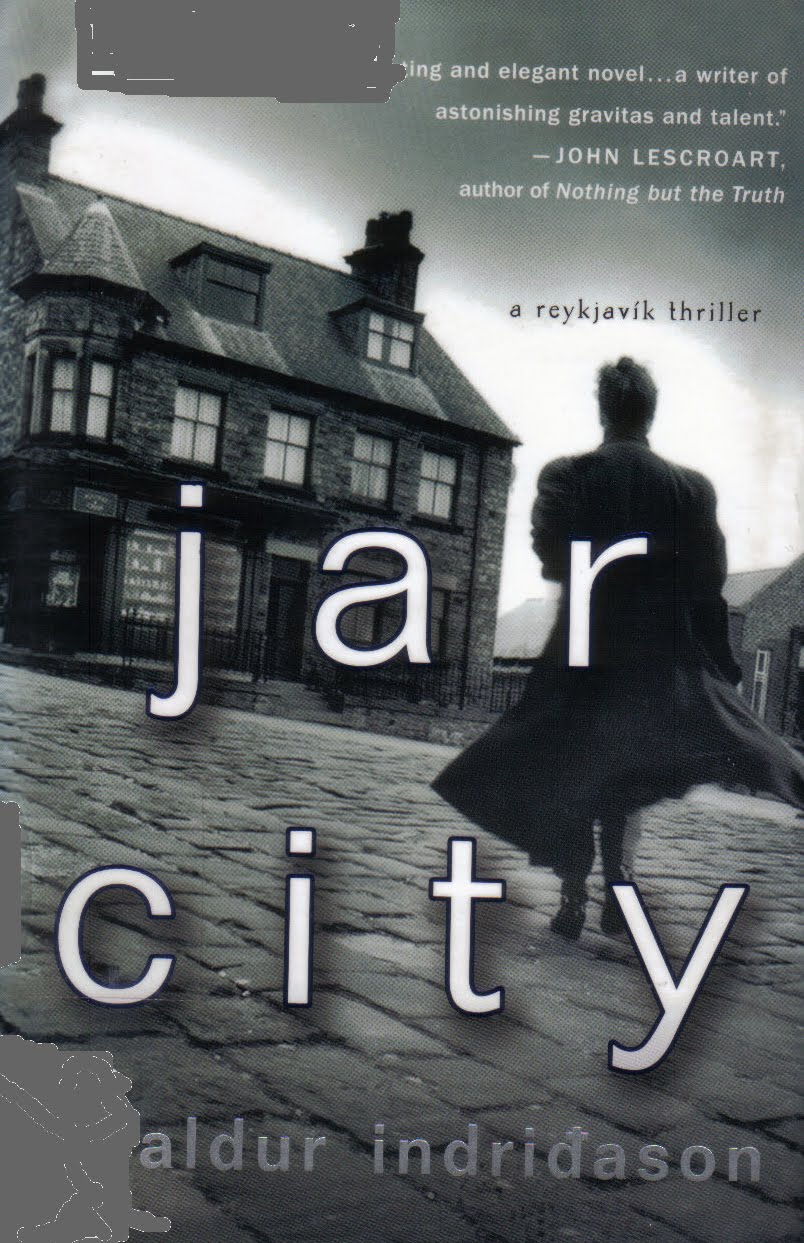
Jar City, by Arnaldur Indriđason


(hb; 2000, 2004: third* book in the Reykjavik Thriller series. Translated from the Icelandic by Bernard Scudder. . . *The first two books, Sons of Dust [1997] and Silent Kill [1998], haven't been translated from the Icelandic to English yet.)


From the inside flap:

"When a lonely old man is found murdered in his Reykjavik flat, the only clues are a cryptic note left by the killer and a photograph of a young girl's grave. Inspector Erlendur, who heads the investigation team, discovers that many years ago the victim was accused, though not convicted, of an unsolved crime. Did the old man's past come back to haunt him?

"As the team of detectives reopen this very cold case, Inspector Erlendur uncovers secrets that are much larger than the murder of one old man - secrets that have been carefully guarded by many people for many years. As he follows a fascinating trail of unusual forensic evidence, Erlendur also confronts stubborn personal conflicts that reveal his own depth and complexity of character."


Review:

Jar City is an excellent, focused police procedural with engaging (and succinctly drawn) characters, riveting action and equally riveting case-based revelations.

Comparisons between Indriđason's Reykjavik Thrillers and the ten-book Martin Beck Mysteries have been repeatedly made, and rightly so: both are reader-grabbing-from-the-git-go, character-progressive and humane reads.

Worth owning, this.

Followed by Silence of the Grave.

#

The first film version was released in Iceland on October 20, 2006.

Ingvar Eggert Sigurðson, billed as Ingvar E. Sigurðson, played Erlendur. Áugústa Eva Erlendóttir played Eva Lind. Björn Hlynir Haraldsson played Sigurður Óli. Ólafía Hrönn Jónsdóttir played Elínborg. Þorstenn Gunnarsson played Holberg. Theodór Júlíusson played Elliði. Kristbjörg Kjeld played Katrín. Þórunn Magnea Magnúsdóttir played Elín. Guðmunda Elíasdóttir played Theodóra.

Baltasar Komákur directed and scripted the film.

#

An American remake is scheduled to hit theatrical screens sometime in 2012. Michael Ross is set to script the film.

When more remake information becomes available, I'll update this book review.

Thursday, August 18, 2011

Old Gods Almost Dead by Stephen Davis


(pb; 2001, 2002: biography)

From the back cover 

"The saga of the Rolling Stones is the central rock mythology. From their debut as the intermission band at London's Marquee Club in 1962 through their 2002/2003 world tour, the Rolling Stones have defined a musical genre and experienced godlike adulation, quarrels, addiction, legal traumas, and descents into madness and death - while steadfastly refusing to fade away. Now, Stephen Davis, the New York Times best-selling author who has covered the Stones for three decades, presents their whole story, replete with vivid details on the Stones's musical successes - and personal excesses."


Review

Intimate, electrifying read about the Stones - their personalities (and inherent flaws), their music (varied in its influences, sometimes groundbreaking, sometimes not) and their lives.

One of the best rock bios I've read in a long while. Worth owning, this - perhaps one of the most comprehensive Stones/rock bios I've ever read.

Friday, July 29, 2011

LZ-'75: The Lost Chronicles of Led Zeppelin's 1975 American Tour, by Stephen Davis


(hb; 2010: rock 'n' roll memoir)

From the inside flap:

"As a young music journalist in 1975, Stephen Davis got the opportunity of a lifetime: an invitation to cover for a national magazine the sold-out 1975 North American tour of Led Zeppelin, the biggest and most secretive rock band in the world. He received a backstage pass, was granted interviews with band members, and even got a prized seat on the band's luxurious tour jet, the Starship. While on duty, he chronicled the Zeppelin tour in three notebooks, but after writing his article in 1975, he misplaced them. After three decades of searching, in 2005 he finally found the notebooks, on the covers of which he had scribbled the words LZ-'75, and unearthed loads of new information from the tour.

"In LZ-'75, Davis offers an unseen look at a pivotal year in the life of the band that includes lost interviews with canny vocalist Robert Plant and the brilliant guitarist Jimmy Page; information on the rock icon who moonlighted as a heroin dealer; revelations about the identity of the lover Robert Plant sings about in 'What Is and What Should Never Be' and 'Black Country Woman'; a detailed chronicle of each performance from a musical perspective and a vivid account of the band members' extravagant, and often troubled, lives on tour."

Review:

Excellent, near-impossible-to-set-down memoir of life on the road with one of the more hedonistic bands of the Seventies - LZ-'75 is an indispensible companion book to Davis' Hammer of the Gods: The Led Zeppelin Saga.

Worth owning, this, if you're a fan of Led Zeppelin or bands of their ilk.

Thursday, July 21, 2011

Plotting and Writing Suspense Fiction by Patricia Highsmith


(pb; 1983: non-fiction)

From the back cover

"Patricia Highsmith, author of Strangers on a Train, The Talented Mr. Ripley, Found in the Street, and many other books, is known as one of the finest suspense novelists. In this book, she analyzes the key elements of suspense fiction, drawing upon her own experience in four decades as a working writer. Among other topics, she talks about: how to develop a complete story from an idea; what makes a plot gripping; the use (and abuse) of coincidence; characterization and the 'likable criminal'; going from first draft to final draft; and writing the suspense short story.

"Throughout the book, Highsmith illustrates her points with plentiful examples from her own work, and by discussing her own inspirations, false starts, dead ends, successes, and failures, she presents a lively and highly readable picture of the novelist at work..."


Review

Reading this is like having a practical and logical, friendly chat with an ego-eschewing writer who's had a wide array of writing experiences, good and bad, and is willing to share them with us, the reading audience.

Excellent read, not only for the above qualities, but for the fact that Highsmith, like any smart writer, acknowledges that each author's process and style is individual - a fact that she notes a few times in Plotting.

I'd recommend this book to writers of any genre, because much of the advice Highsmith offers, as far as publishing and preparation is concerned, applies to most, if not all, writing genres.

Worth owning, this.

Monday, July 04, 2011

Smiley's People, by John le Carré


(hb; 1979: fifth novel in the George Smiley series; third novel in the Karla trilogy)

From the inside flap:

"In Paris, a Russian woman is accosted by a Soviet agent, who offers to send her daughter West to join her. In Hamburg, a frightened Estonian emigré performs a secret mission. And in London, George Smiley - once head of British Intelligence - is called from retirement to identify the body of a former British agent. As Smiley gets involved in the tangle of events, all clues lead in one direction - to Karla, Smiley's archenemy and opposite number in Russia. This one time Karla is vulnerable. At last, after all these years, Smiley begins playing Karla's ruthless, relentless game, for that is the only way he can win."

Review:

This wrap-up of the Karla trilogy is more like Tinker, Tailor, Soldier, Spy than The Honourable Schoolboy in its scope: it focuses on a few select locales and thoroughly developed characters, as well as George Smiley's quest to destroy Karla's influence.

Exemplary read, better than Honourable (which is barely referenced in Smiley's), and great finish to the Karla-Smiley chess match.

Check it out.

Followed by The Secret Pilgrim.

#

The resulting television mini-series, bearing the same title, aired in England on September 20, 1982. It first aired stateside on October 25, 1982.

Alec Guinness resumed his role of George Smiley. Bernard Hepton resumed his role of Toby Esterhase. Anthony Bate resumed his role of Sir Oliver Lacon. Michael Byrne played Peter Guillam. Bill Paterson played Lauder Strickland. Andy Bradford played Ferguson. Barry Foster played Saul Enderby.

Eileen Atkins played Madame Ostrakova. Tusse Silberg played Alexandrea Ostrakova. Vladek Sheybal played Otto Leipzig. Ingrid Pitt played Elvira. Curd Jürgens played The General. Michael Lonsdale played Anton Grigoriev. Michael Gough played Mikhel. Paul Herzberg played Villem Craven.

Lucy Fleming played Molly Meakin. Julia McCarthy played Millie McCraig.

An uncredited Alan Rickman played Mr. Brownlow.

Patrick Stewart, this time credited, reprised his role of Karla.

Simon Langton directed the six-episode mini-series, from a screenplay by co-authored by book author John le Carré and John Hopkins.

Monday, June 20, 2011

Audition by Ryû Murakami


(pb; 1997, 2009, 2010. Translated from Japanese to English by Ralph McCarthy.)

From the back cover

". . . Aoyama, a widower who has lived with his son since his wife died seven years ago, decides that it is time to remarry. Since Aoyama is a bit rusty when it comes to dating, a filmmaker friend proposes that he stage auditions for a movie he never intends to produce in order to cast the perfect woman as his bride. Only one of the applicants catches Aoyama's attention: Yamasaki Asami, a striking young ballerina with a mysterious past. Blinded by his infatuation, Aoyama discovers too late that she is a far cry from the innocent young woman he imagined her to be."


Review

Short, taut and emotionally-effective novel. Audition begins as a personal drama about a lonely man trying to find love, a quest that results in sadistic and horrifying situations.

Murakami wastes no words in Audition. Between the author's deliberate, sharp focus and pacing, and an increasing sense of unease, this disturbing novel is unique and excellent. It is not for the squeamish.

#

This was released as a film in Japan on March 3, 2000.

Ryo Ishibashi played Shigeharu Aoyama. Eihi Siina played Asami Yamazaki. Tetsu Sawaki played Shigehiko Aoyama. Jun Kunimura played Yasuhisa Yoshikawa. Miyuki Matsuda played Ryoko Aoyama. Toshie Negishi played Rie. Yuuto Arima played "Shigehiko as a child". Ayaka Izumi played "Asami as a child".

Takashi Miike directed the film, from a script by Daisuke Tengan.

Tuesday, May 10, 2011

The Adventures of Lord Iffy Boatrace, by Bruce Dickinson


(pb; 1990, 1992: prequel to The Missionary Position)

From the back cover:

"When the ancestral fortune dries up, there's only one solution for Lord Iffy Boatrace, destitute, transvestite Laird of Findidnann, and his faithful butler, Butler. A wheeze to squeeze every last drop of cash out of those old school chums who'd done everything they could to forget him. . .

"Come in Brian Taylor and your voluptuous, insatiable wife; yucky yuppy perfect couple Mark and Cynthia; bumbling beefcake bozo Roderick Morte D' Arthur Tennison!

"Upper class twits, the lot of them. Ripe for the picking. And drawn by the short and curlies to Findidnann Hall. . ."

Review:

This manic-paced, audaciously lusty and zany-literate sex romp is one of the funniest books I've ever read; there are so many off-color quotable lines that I was laughing at pretty much every page of this 150-page novel.

Politically correct folk will want to avoid this out of print book, which sports a Sir Arthur Conan Doyle/The Hound of the Baskervilles plot structure: Boatrace unabashedly and pithily skewers music critics, English aristocracy, feminists, racial stereotypes, vegetarianism, and other social elements.

While reading this, I imagined this as A Shot in the Dark-era Blake Edwards film (whose screenplay was co-authored by William Peter Blatty): this book is that erudite and uproarious.

Worth owning, if you appreciate raunchy, quick-witted and -plotted humor, and/or Dickinson's heavy metal endeavors.

Followed by The Missionary Position.

Monday, May 02, 2011

The Cry of the Owl by Patricia Highsmith

(hb; 1962)

From the back cover:

"[The Cry of the Owl] begins with an act of naïve voyeurism. Robert Forester, a depressed but fundamentally decent man, liked to watch Jenny through her kitchen window -- a harmless palliative, as he saw it, to his lonely life and failed marriage. As he is drawn into her life, however, recriminations of his simple pleasure shatter the deceptive calm of this small Pennsylvania town. With striking clarity and horrible inevitability, Forester is caught up in a series of deaths in which he is the innocent bystander, presumed guilty. . ."


Review:

This plot- and writing-taut, unsettling thriller about a socially maladaptive man who gets bound up in an ever-worsening - and increasingly violent - cycle of paranoia, isolation and murders is near-impossible to set down. Highsmith's masterful trademark elements - oddball/unpopular protagonists, mounting unease and social violence, and, often, resulting corpses - is on full display here, making this an excellent read.

Sad, memorable, echoes-real-life work. Worth checking out.

•

Three film versions have resulted from this novel.

The first version, Der Shrei der Eule, aired on German television in 1987.

Matthias Habich played Robert. Birgit Doll played Johanna. Jacques Breuer played Karl. Fritz Lichtenhahn played Lippenholtz. Doris Kunstmann played Vicky. Roger Fritz played Ralph. Gernot Endeman played Jakob. Hans Christian Blech played Dr. Knapp.

Tom Toelle directed the film, from a screenplay by Peter Märthesheimer and Pea Fröhlich.

•

The second version, bearing the same title as the novel, was released in France on October 28, 1987. It was released stateside on October 16, 1991.

Claude Chabrol directed the film, from a script he co-authored with Odile Barski.

Christophe Malavoy played Robert. Mathilde May played Juliette. Jacque Penot played Patrick. Jean-Pierre Kalfon played "Police Commissioner". Virginie Thévenet played Véronique. Patrice Kerbrat played Marcello. Jean-Claude Lecas played Jacques. Agnès Denèfle played Suzie. Isabelle Charraix played Mme Tessier. Gille Dreu played M. Tessier.

•

The third version, also bearing its source novel's title, was released in Germany on February 7, 2009. It was released stateside on March 12, 2010.

Paddy Considine played Robert Forester. Julia Stiles played Jenny Thierolf. James Gilbert played Greg Wyncoop. Caroline Dhavernas played Nickie Grace. Gord Rand played Jack Nielson. Charlotte Sullivan played Sally Nielson.

Jennifer Kydd played Susie Escham. Karl Pruner played Mr. Jaffe. R.D. Reid played Mr. Kolbe. Marcia Laskowski played "Nickie's Lawyer". Phillip Mackenzie played "Lavigne Client".

Jamie Thraves scripted and directed the film.


Saturday, April 23, 2011

Jesus' Son, by Denis Johnson


(pb; 1992: story anthology)

From the back cover:

"Jesus' Son, the first collection of stories by Denis Johnson, presents a unique, hallucinatory vision of contemporary American life unmatched in power and immediacy and marks a new level of achievement for this acclaimed writer. In their intensity of perception, their neon-lit evocation of a strange world brought uncomfortably close to our own, the stories in Jesus' Son offer a disturbing yet eerily beautiful portrayal of American loneliness and hope."

Review:

Jesus's Son is a raw-nerve, febrile-intense "fractured novel" anthology that takes place during the early 1970s, where a heroin addict (nicknamed "F**khead") narrates his largely-unfortunate relationships (which often result in overdoses, gunshot wounds, pregnancy and car crashes), as well as his eventual attempts to "get clean."

Beautiful, situationally harsh, darkly funny, sensitive and stunning work.

One of the best story anthologies I've ever read, this. Worth owning, if you like elegiac, poetic and gritty writing.

•

The film version, bearing the same title as its source anthology, was released stateside on June 16, 2000.

Billy Crudup played FH (aka "F**khead"). Robert Michael Kelly played "Salesman". Samantha Morton played Michelle. Steve Buck played Richard. Brooke Rachel Shive, billed as Brooke Shive, played Beatle. Mark Webber played Jack Hotel. Michael Shannon, billed as Mike Shannon, played Dundun. Ben Shenkman played Tom. Scott Oster played Stan. John Ventimiglia played McInnes.

Jack Black played Georgie. Denis Leary played Wayne. Will Patton played John Smith. Greg Germann played Dr. Shanis. Miranda July played "Black-Eyed Nurse". Dennis Hopper played Bill. Holly Hunter played Mira. Alan Davidson played Snakeskin.

Alison Maclean directed the film, from a script by David Urrutia, Oren Moverman and Elizabeth Cuthrell (who also played a "Diner Waitress" in the film).

Monday, February 07, 2011

Mary Ann in Autumn, by Armistead Maupin

(hb; 2011: Book Eight in the Tales of the City series)

From the inside flap:

"Twenty years have passed since Mary Ann Singleton left her husband and child in San Francisco to pursue her dream of a television career in New York. Now a pair of personal calamities has driven her back to the city of her youth and into the arms of her oldest friend, Michael 'Mouse' Tolliver, a gardener happily esconced with his much-younger husband.

"Mary Ann finds temporary refuge in the couple's backyard cottage, where, at the unnerving age of fifty-seven, she licks her wounds and takes stock of her mistakes. Soon, with the help of Facebook and a few old friends, she begins to reengage with life, only to confront fresh terrors when her checkered past comes back to haunt her in a way she never could have imagined.

"After the intimate first-person narrative of Maupin's last novel Michael Tolliver Lives, Mary Ann in Autumn marks the author's return to the multicharacter plotlines and darkly comic themes of his earlier work. Among those caught in Mary Ann's orbit are her estranged daughter Shawna, a popular sex blogger; Jake Greenleaf, Michael's transgendered gardening assistant; socialite DeDe Halcyon-Wilson; and the indefatigable Anna Madrigal, Mary Ann's former landlady at 28 Barbary Lane."


Review:

Mary Ann in Autumn is as warm, fresh, joyous, City-centric and charming as the original Tales of the City novel, with a dark mystery element (much like the original novel, More Tales of the City and Further Tales of the City).

The mystery element in this gradual-passing-of-the-torches novel isn't such a mystery (a mild disappointment), but the writing is tight and witty, and the characters still feel like family, as usual, with a welcome return to form - as much as I liked Michael Tolliver Lives, I prefer Maupin's multicharactered storylines, which structure his best novels.

Readers familiar with Maupin's work will probably recognize Gabriel Noone, who gets a mention in Mary Ann. (Noone is the main character in one of Maupin's non-Tales books, The Night Listener - further proof of Maupin's ability to seamlessly bring his otherwise disparate characters together, and making his readers smile.)

I love this book. One of my favorite entries in this series. Worth owning, this.

Followed by The Days of Anna Madrigal.

Friday, February 04, 2011

The Animal Factory by Edward Bunker

(pb; 1977)

From the back cover

"The Animal Factory goes deep into San Quentin, a world of violence and paranoia, where territory and status are ever-changing and possibly fatal commodities. Ron Decker is a newbie, a drug dealer whose shot at a short two-year stint in the can is threatened from inside and outside. He's got to keep a spotless record or it's ten to life. But at San Quentin, no man can steer clear of the Brotherhoods, the race wars, the relentlessness. It soon becomes clear that some inmates are more equal than others; Earl Copen is one of them, an old-timer who has learned not just to survive but to thrive behind bars. Not much can surprise him -- but the bond he forms with Ron startles them both; it's a true education of a felon."


Review

The Animal Factory is an immediately immersive, character-intriguing and waste-no-words novel that's simultaneously a caveat and a pulp read (inherent, given its subject matter).

This, for me, is a perfect novel. All the delicate plot and character elements work together to form a raw-truth, hard-to-lay-down read that should appeal to those who've read prison writing before, as well as those who haven't.

Worth owning, this. Landmark, informative work.

#

The resulting film was released stateside on January 24, 2000.

Steve Buscemi produced and directed the film, from a script by book author/co-producer Edward Bunker and John Steppling.

Willem Dafoe played Earl Copen. Edward Furlong played Ron Decker. Danny Trejo played Vito. Mark Boone Jr. played Paul Adams. Seymor Cassel played Lt. Seeman. Mickey Rourke played Jan the Actress.

Tom Arnold played Buck Rowan. John Heard played James Decker. Chris Bauer played Bad Eye. Michael Buscemi, Steve Buscemi's brother, played Mr. Herell.

Book author Edward Bunker played Buzzard. Director Steve Buscemi played A.R. Hosspack. Independent filmmaker and actor Larry Fessenden, billed as Larry Fesenden, played Benny. Independent filmmaker, producer and actor Sal Mazzotta played Florizzi.


Friday, January 21, 2011

The Moon is Down, by John Steinbeck

(pb; 1942: novella)

From the back cover:

"A beautiful, provincial Norwegian town had been at peace for so long that its people had forgotten the protocol of war. Then one Sunday the German soldiers came. . ."

Review:

The Moon is Down is a scathing, intensely personal indictment of imperialism and war. There's not one wasted word is in this stark work, which baldly foreshadows the futile, occupational horrors and (sometimes ironic) disillusionment suffered by both the invaders, and their captives.

Stunning, timely work; worth owning.

•

The film version was released stateside on March 14, 1943.

Henry Travers played Mayor Orden. Lee J. Cobb played Doctor Albert Winter. Dorris Bowdon played Molly Morden. Margaret Wycherly played Mme. Sarah Orden. William Post Jr. played Alex Morden.

Cedric Hardwicke played Col. Lanser. Peter van Eyck played Lt. Tonder. Henry Roland played Capt. Loft. E.J. Ballantine played George Corell. Hans Schumm played Capt. Bentick.

Irving Pichel directed the film, from Nunnaly Johnson's screenplay.

Wednesday, January 12, 2011

The Enormous Crocodile, by Roald Dahl

(hb; 1978: children's picture book. Illustrations by Quentin Blake.)

From the inside flap:

"When the Enormous Crocodile decides he would like a nice juicy little child for lunch, the other animals - his friend the Notsobig One, Humpy-Rumpy the Hippopamus, Trunky the Elephant, Muggle-Wump the Monkey, and the Roly-Poly Bird -- are horrified.

"But the Enormous Crocodile continues on his way with his secret plans and clever tricks, which will bring deliciously exciting shivers to the spine of every young reader.

"In the end, he get exactly what he deserves.

"One of Roald Dahl's most popular picture books. . . The Enormous Crocodile is now in a storybook edition for those beginning to read on their own. It was the first of Roald Dahl's stories to be illustrated by Quentin Blake, marking the beginning of a wonderfully successful relationship."

Review:

Darkly serendipitous wordplay and tone abound in this sublime moral (i.e., the moral is never stated outright) beginning-to-read children's book.

Blake's illustrations are true to Dahl's almost-shocking-for-a-kid's-book vision, storyline and characters, adding to the hijinky and comic payback feel of The Enormous Crocodile.

Going to be chuckling over this one for a while. Worth owning, even if you're an adult without kids.