Tuesday, June 28, 2022

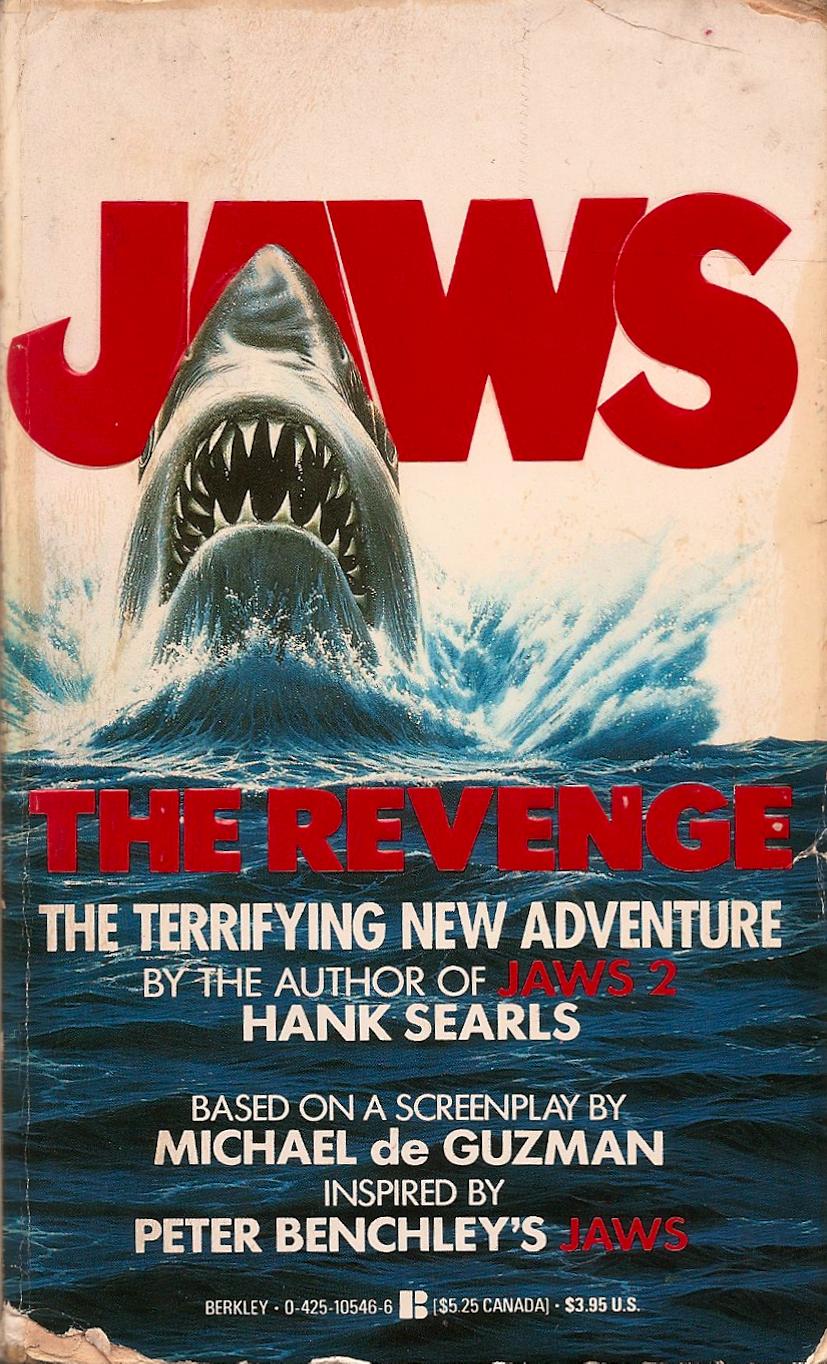
Jaws: The Revenge by Hank Searls


(pb; 1987: movie tie-in, based on Michael De Guzman’s screenplay)

From the back cover

“This time it’s personal.

“The lives of the Brody family have been devastated by a natural force.

“A force that glides, silent and unseen, beneath the ocean surface—ready to strike out with a relentless fury.

“To Ellen Brody it is evil incarnate. And it must be destroyed. Once and for all.

“Even if it costs Ellen her life.”


Review

Twelve years have passed since the events of Jaws. Martin Brody died a few years ago, a heart attack—his heart was weakened by the shock he was jolted by while electrocuting the great white shark ten years prior, in Jaws 2. Now Ellen, his wife, is a nervous wreck, especially when Sean, Ellen and Martin’s second, youngest son, goes out to remove an obstruction from the Amity harbor one December night. Then another great white, spawn of the previous two killer sharks, eats Sean, a police officer like his dad.

This spirals Ellen further into grief, fear, rage and more than a touch of craziness. She allows her eldest son Michael, a marine biologist (much to her dismay), to take her to the Whiskey Cay/Prince George Town areas in the Bahamas. The shark follows the tides (hello, El Niño) to where Ellen is—to the hysterical widower and bereft mother, it smacks of grim and terrifying destiny.

Searls’s writing, as it was with his Jaws 2 novel, is solid and cinematically visual. Unfortunately, this third book outing in the Jaws franchise* saddles the worthwhile author with a ridiculous set-up and an annoying lead protagonist (Ellen), undermining most of the thrills and other pleasures Revenge might’ve had. Revenge is also undercut by a subplot involving Papa Jacques (a voodoo priest who has a grudge against Michael Brody and a psychic link with the flesh-rending shark)—another ridiculous conceit, one that the tightly edited film (credit Michael Brown for that) eschews. The film version, keeping with franchise tradition, also cuts out the book’s Mafia B-storyline (this time it’s a subplot about pilot Hoagie Newcombe and Bahaman drug smugglers, particularly the murder-happy and over-the-top Rico Lomas).

Revenge’s climax, with its cross-cut editing (somewhat reflected in the movie), is especially well-written and gripping, despite Ellen’s hysteria, the shark’s voodoo connections, and Ellen/the film-version’s conceit that the shark followed her to the Bahamas—at least Searls tried to provide a reasonable rationale for why the shark did the latter, something the movie version barely bothered with.

If you’re looking for the bookish thrills of the two previous novels, skip Revenge, and pretend the story ended with Jaws 2.

The film version was released stateside on July 17, 1987.


(*There were four movies. Revenge’s film version was preceded by Jaws 3-D, 1983, which was not novelized.)

Tuesday, June 14, 2022

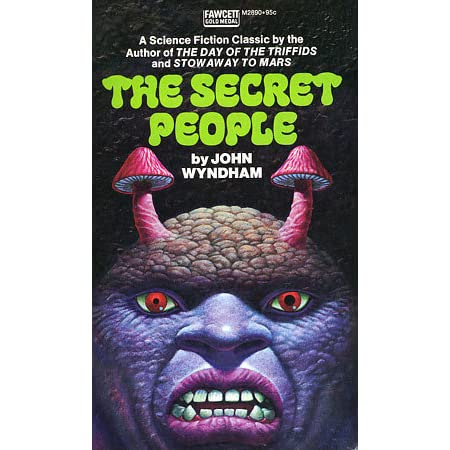
The Secret People by John Wyndham


(pb; 1935)

From the back cover

“The ‘new sea’ was teeming with a secret life.

“It was the world’s greatest engineering feat─the flooding of part of the Sahara desert. But the new waters that covered up the land also threatened to destroy an ancient, secret civilization beneath the earth.

“When Mark Sunnet’s plane crashed into the New Sea, he and beautiful companion, Margaret Lawn, were taken prisoners by these secret people. They were taken deep beneath the earth into strange, dark caverns. Caverns that seemed to hold no hope for escape.

“But Mark and Margaret had to escape. For now, suddenly, they were faced with two terrors─the secret people who were to be their executioners and the merciless New Sea that threatened to kill them all.”


Review

Wyndham, who wrote under a few other names, imbues Secret’s familiar topside-adventurers-beneath-the-earth with his usual vivid, classic science fiction writing and twists. By today’s ADHD writing standards the story comes off as chatty in certain parts (particularly near the overlong finish, when a verbose Sunnet tells Margaret key information).

There’s also a possibly-disturbing-for-modern-audiences element to Secret: Wyndham’s omniscient-author, repeated, unfortunate use of the character-centric phrase of “the Negro Zickle” (though most of multinational characters of various skin colors don’t refer to the heroic, if language-challenged* man as such─they simply call him Zickle). Having said that, Wyndham’s era-distinctive (possible) racism is born of ignorance, not meanness─the author, who published this in the mid-1930s, only shows Zickle as a smart-minded and man-of-action character.

Secret, set in September 1964, is a good read if you can overlook a few instances of British speechifying and its era-centric, unintentional (possible) racism, its flaws ameliorated by solid, imaginative, and adventure-minded science fiction, Buck Rogers-esque fight scenes, and a sly villain (Miguel Salvades).   


[* = Zickle, a tribesman, was taken from his village where English was not spoken. His story, which may or may not include the events of Secret, would make for an interesting modern spin-off tale.]


"Werewolf By Night" Omnibus by various writers and artists (Part 1 of 2)


(over-sized hb; 2015: graphic novel)

From the inside flap

“From the streets of Los Angeles, across Europe and into unnamed worlds, Transylvanian-American Jack Russell turned his curse into a blessing for others. During his quest for control or cure, he met many of Marvel’s mightiest monsters as allies, enemies or either—including John Blaze, Brother Voodoo, , the Man-Thing, Morbius the Living Vampire, and even Dracula and the Frankenstein Monster! His clashes with two very different vigilantes made him an opponent of the heinous Hangman and a friend with ex-mercenary Moon Knight, commissioned by the cryptic Committee to tame him!

“Bound body and soul to the gruesome grimoire called the Darkhold, the Werewolf and his friends—mortal and otherwise—found themselves at the center of sorcery spanning the centuries: Aelfric the Mad Monk, Marcosa the Soul-Eater, the terrible Taboo and the modern era’s Moondark the Magician! Threats ranging from such mortal monstrosities as Half-man and DePrayve to the all-but-omnipotent forces of Doctor Glitternight and the Starseed harried the hairy hero, who inevitably rose—triumphant—even more steadily than the full moon!

“Featuring the Army of Terror, the Brotherhood of Baal, the Hellrunners and the hordes of Hydra! Demons and androids, Hollywood vampires and zombie police officers, mad scientists, madder monsters, and more! Guest-starring Spider-Man and Iron Man, and featuring the origin of Tigra of the Avengers!”


Overall review

Caveat: (possible) minor spoilers in this review. Part 2 of this review is here.

Werewolf is a fun, well-written and excellently illustrated comic book, with main characters that, within the comic book genre, are relatively smart and consistent in their characterizations—though Jack Russell’s constant lack of planning about how to lock himself up (or how to sedate himself) when he’s a werewolf seems comic book convenient, as he doesn’t seem to try too hard to solve the problem. That minor quibble aside, Werewolf is mostly a slice-of-1970s-monster blast-read, an Old School joy ride down memory lane for those who thrill to such things. Worth owning, this.


Review, issue by issue

Marvel Spotlight: ‘Werewolf By Night’ – “Night of Full Moon—Night of Fear!” (#2): Jack Russell’s eighteenth birthday is marred by familial betrayal, tragedy, a nightmarish curse, and murder.


Marvel Spotlight: ‘Werewolf By Night’ – “The Thing in the Cellar!” (#3): Two months after his mother’s murder, an on-the-run Jack Russell takes on a motorcycle gang to protect his sister Lissa). He’s later kidnapped by a couple, Nathan and Andrea Timly, who want to “learn the secrets of the Darkhold,” somehow connected to his father, killed in the Balkan by villagers.


Marvel Spotlight: ‘Werewolf By Night’ – “Island of the Damned!” (#4): Jack Russell meets L.A. reporter (Buck Cowan), a potential ally in Jack’s search for the Darkhold. This leads them to Miles blackgar’s Monterey, CA-adjacent island where Blackgar engages in mysterious scientific experiments.


Werewolf By Night: “Eye of the Beholder!” (#1): Buck Cowan helps Jack Russell escape from Miles Blackwell’s Doctor Moreau-esque island, now run by his once-sympathetic-to-Jack, Gorgon-gazed daughter (Marlene, first seen in Marvel Spotlight #4). The wealthy Blackgars and their reluctant, mutant henchman (Strug) pursue them and kidnap Jack’s sister, Lissa.


Werewolf By Night: “The Hunter—and the Hunted!” (#2): Terri (Jack Russell’s romantic interest) helps Jack interpret his warlock father’s spell book (Darkhold). Another villain, a bald giant named Cephalos, tracks Jack down and tries to transfer Jack’s animal strength and resilience into his villainous body.


Werewolf By Night: “The Mystery of the Mad Monk!” (#3): While translating the Darkhold (written in twelfth century Latin) for Jack, Father Ramon Jacquez, introduced in the last issue, is now controlled by a fire-scarred, eight-hundred-year-old satanic monk (Aelfric the Mad Monk). Jocquez/Aelfric tells Jack Russell about the source of his lycanthropy (an eighteen-hundred-year-old demon), before trying to kill Jack and Lissa. There’s some excellent witchsploitation flick-worthy artwork in this issue, and this is one of my favorite issues in the series thus far.


Werewolf By Night: “The Danger Game!” (#4): Twenty-four hours after the events of the previous issue, a boastful big game hunter (Joshua Kane) hunts Jack Russell (in his werewolf form) in an abandoned L.A. western movie set.

Beyond its obvious story lift, this issue sports a nice visual shout-out to Richard Connell’s 1924 story “The Most Dangerous Game,” along with effective poetic karma at the end. Another favorite issue in this series.


Werewolf By Night: “Life for a Death!” (#5): Luther Kane, scientist brother of Joshua Kane (last seen in issue 4), offers Jack Russell a cure for his lycanthropy-cursed sister (Lissa) if Jack kills someone for him. Luther’s target: Justin Hemp, a “reclusive millionaire” who negatively altered Luther’s fortunes. Like the two issues before it, this is an above-average-for-the-series issue, one where the storylines and characters begin to gel.


Werewolf By Night: “Carnival of Fear” (#6): When Buck Cowan (Jack Russell’s reporter friend), Lissa (Jack’s sister) and Jack visit a traveling carnival, a swami (Rihva) cages Jack, with the intention of turning the reluctant lycanthrope into a sideshow attraction. Meanwhile, in Los Angeles, Detective Lou Hackett begins looking for Jack, whom he suspects is a night-beast.


Werewolf By Night: “Ritual of Blood!” (#7): Lissa Russell and Buck Cowan, investigating Jack Russell’s abrupt disappearance, fall under Rihva’s sway. Seems the swami, introduced in the last issue, needs Jack’s shapeshifter blood for a Bloodstone ritual—a ceremony that will end with Jack’s death.


Werewolf By Night: “The Lurker Behind the Door!” (#8): After escaping from Caliope’s Carnival and Circus, Jack Russell accidentally frees a cave-bound, fire-breathing demon (Krogg) who intends to make Jack his first post-cave meal.


Marvel Team-Up Featuring: Spider-Man and the Werewolf—“Wolf at Bay!” (#12): In San Francisco, Peter Parker/Spider-Man—taking on an out-of-town photo assignment to process his grief for the recently murdered Gwen Stacy—encounters Jack Russell in werewolf form. Seems Jack was transformed by a Svengali magician (Moondark) who has the entire bayside city under his hypnotic control.


Werewolf By Night: “Terror Beneath the Earth!” (#9): Jack Russell, after a skirmish with a seemingly mutated and rags-clad monster, returns to his stepfather’s (Philip Russell) home where he, Philip, and Lissa are stalked by a freakish mini-army under the command of Sarnak, a mysterious master with a “control flute.” Aside from Jack’s plot-convenient/unlikely memory lapses in one part—any werewolf worth his fangs would surely monitor moon phases—this is a solid comic book read.


Werewolf By Night: “The Sinister Secret of Sarnak!” (#10): Sarnark, the “Master of Sound,” unleashes his “army of fear” on Los Angeles after Jack Russell escapes from him—with Jack’s sister, Lissa, still in Sarnak’s clutches.

Meanwhile, Detective Lou Hackett continues his investigation of Jack and his family. Good, character-interesting twist-finish to this issue, although Sarnak’s reasons for working The Committee (a group of gangsters) are thin, too cartoonish/comic book-y, even for a comic book villain.


Werewolf By Night: “Comes the Hangman” (#11): The Committee, who kidnapped Philip Russell (Jack Russell’s stepdad) last issue, begin to question him. Jack, in human form, moves out of Buck Cowan’s apartment, and in his lycanthropic form, Jack battles the corruption- and justice-obsessed Hangman, who “rescues” women.


Werewolf By Night: “Cry Werewolf!” (#12): Jack Russell’s battle with the scythe- and noose-wielding Hangman intermittently continues. Jack, in human form, goes swimming with his skimpy bathing-suited apartment-building neighbors, Clary Winter (a.k.a. Melody Tune, an actress) and Samantha (“Sam”). While doing so, Jack meets his brusque new neighbor, Mr. Coker, whose intentions toward Jack are uncertain.


Werewolf By Night: “His Name is Taboo” (#13): Jack Russell (in werewolf form) is mind-manipulated by Topaz, a willful, sexy telepath-mind mutant who works for Taboo, a vengeful sorcerer with a grudge against Philip Russell (Jack’s stepfather). Taboo also seeks the Darkhold, “the Book of Sin,” which was destroyed in the third issue of Werewolf By Night, unbeknownst to Taboo and Topaz. Fun, fast twists and characters in this one, a standout issue.


Werewolf By Night: “Lo, the Monster Strikes” (#14): Jack/Werewolf fights Algon, Taboo’s lumpy-fleshed monster (with Philip Russell’s mind transposed to it), to escape, with new ally (Taboo) in tow. Revelations about Philip, Gregory Russoff (Jack’s father) and Jack’s mother are revealed.


The Tomb of Dracula: “Enter: Werewolf By Night” (#18): In this crossover issue, Jack Russell and Taboo travel to Transylvania, where Gregory Russoff’s manor is located—Jack and Topaz seek the details regarding Jack’s father’s life and death. While there, they cross paths with Dracula, dramatic and bloodthirsty as ever.


Werewolf By Night: “Death of a Monster!” (#15): Jack Russell and Topaz find Jack’s father’s (Gregory Russoff) diary in Russoff Manor, Jack’s familial Transylvanian estate. Frank Drake and Rachel Van Helsing, the former a descendant of Dracula, also hunt the iconic bloodsucker within the same Balkan village, their endeavor made easier by Dracula, who—like many Werewolf By Night characters—constantly announces his intentions.


Werewolf By Night: “Death in the Cathedral!” (#16): Jack Russell battles a Parisian mutant terrorist (Hunchback) in France while Topaz tries to balance Jack’s human/lycanthropic nature.


Werewolf By Night: “The Behemoth!” (#17): After barely escaping their debacle with the Hunchback and Parisian gendarme, Jack Russell and Topaz return to Jack’s Los Angeles home, where the Committee, who’ve not been idle under the leadership of Baron Thunder. Thunder has created the Behemoth, “a veritable mountain of synthetic, clay-like muscle,” and a hard-to-stop enemy of Jack and his family. Meanwhile, Raymond Coker—Jack’s occultist neighbor in the Colden House apartment complex—has advanced in his supernatural plans, yet to be fully revealed.

More concerning is Lissa Russell, Jack’s about-to-turn-eighteen sister, who is likely to inherit their familial lycanthropic curse.


Werewolf By Night: “Murder By Moonlight!” (#18): Lieutenant Lou Hackett shows up at Jack Russell’s door talking about werewolves, making Jack nervous—just as an assassin with an axe (Ma Mayhem) attacks Jack. The complicated battle between Jack and Mayhem soon involve occult-ritualizing neighbor Raymond Coker, who becomes an (offscreen) a black-blue-furred lycanthrope himself.

Lots of crazy action in this one—this is especially fun, with plot-convenient weirdness involved. Also: The Committee, who’ve been watching Jack’s stepdad (Philip Russell), kidnap Jack’s sister Lissa.


Werewolf By Night: “Vampires on the Moon!” (#19): Raymond Coker and Jack Russell, in werewolf form, fight vampires (Louis Belski and Liza) in a film studio. Later, the lycanthropes discover a book (Libro del Malditos) in Geraldo Kabel’s (Joshua Kane’s estate executor) office. Libro is a book with alarming, possibly fatal news for the two werewolves.


Werewolf By Night: “Giant-Sized Creatures ‘featuring: Werewolf By Night’” (Special Issue #1): Jack Russell, again in werewolf form, and Tigra the Were-Woman fight green-suited HYDRA agents. Tigra’s superhero/shapeshifter origin story is told.


Werewolf By Night: “Eye of the Wolf!” (#20): A lycanthrope stalks Raymond Coker (whom Lieutenant Lou Hackett suspects is a werewolf) and Jack Russell . A lawyer (Gerald Kabal) accidentally gives Jack an animal-eye ring that allows Jack to think as a rational human while he’s in his cursed furry form. Jack, in said form, battles Baron Thunder, head of the committee and “former client” of Kabal, in Thunder’s manse on Moonrise Hill, “a combination of a haunted house and condemned tenement” (Jack’s description). While there, Jack discovers the true identity of a Ma Mayhem (last seen in Werewolf By Night issue 18). Jack also rescues his sister Lissa from the house on Moonrise Hill.


Werewolf By Night: “One’s Wolf’s Cure. . . Another’s Poison!” (#21): Lieutenant Lou Hackett interrogates lawyer Geraldo Kabal about the green animal-eyed ring Hackett found at Joshua Kane’s place (Werewolf By Night #4). Hackett, wearing the ring, becomes a werewolf and attacks Jack Russell and his “wolf-brother” Raymond coker while they’re wolfed-out.


Monsters Unleashed magazine (#6) – first chapter in a two-part Werewolf By Night “prose feature,” (“Panic By Moonlight”) by Gerry Conway: A motorcycle gang takes the occupants of Jack Russell’s apartment building. (This story takes place between issues 17 and 19 of Werewolf By Night.)


Monsters Unleashed magazine (#7) – second chapter in a two-part Werewolf By Night “prose feature,” (“Madness Under a Mid-Summer Moon”) by Gerry Conway: Continuation of the story about a biker gang attacking and imprisoning Jack Russell, Raymond Coker and their Colden House neighbors—unfortunately for the bikers, they picked full-moon nights to do this!

Fun, mostly well-written (the bad guys’ reason for doing bad deeds feels underwhelming and forced).
Eddie's Boy by Thomas Perry


(hb; 2020: fourth book in the Butcher’s Boy series)

From the inside flap

“Michael Schaeffer is a retired American businessman, living peacefully in England with his aristocratic wife. But her annual summer party brings strangers to their house, and with them, an attempt on Michael’s life. He is immediately thrust into action, luring his lethal pursuers to Australia before venturing into the lion’s den─the States─to figure out why the mafia is after him─again─and how to stop them. . .”


Review 

The fourth Butcher’s Boy novel maintains the engaging, action-punctuated, and tautly written immediacy that make up the story DNA of Perry’s earlier Butcher’s books. This time Michael Schaeffer’s looks back at his childhood with butcher/hitman Eddie Mastrewski as his strict-but-kind father figure run longer and make up a much bigger part of Eddie’s.

When, a decade after the events of The Informant, another hit squad tries to take him out in his England estate (and he, with imaginative and slick efficiency, dispatches them), he is forced to return to stateside to deal with the last of the mobsters who likely ordered his murder. Elizabeth Waring, the FBI agent who’d previously hunted three times is now a high-ranking government employee and thrown into the hunt for Schaeffer (whose real name she still doesn’t know), though this time─as with the two previous books─she's friendlier with him.

Eddie’s is another great entry in the Butcher’s series, with all the elements that initial books in the (thus far) quadrilogy make them standout reads in the action/thriller genre.

Tuesday, June 07, 2022

The Thing by Alan Dean Foster


(pb; 1982: movie tie-in novel)


From the back cover

“TWELVE MEN

Trapped in the Antarctic.


“ELEVEN

Discover the intruder.


“TEN

Battle the alien force.


“NINE

Agonize for the answer.


“EIGHT

Desperate to be spared.


“SEVEN

Consumed one by one.


“SIX. . . FIVE. . . FOUR. . . THREE. . .


“They will all die.

Unless something stops THE THING.”


Review

Foster’s movie novelization, based on Bill Lancaster’s original screenplay, like its filmic counterpart, is compelling, paranoid, brutal, horrific, and freezing (in its implications, stakes, and setting). In Foster’s book, though, the characters’ backstories and inclinations are more explicit (e.g., Macready’s acknowledgment of his Vietnam experiences) than the movie. Also, the characters’ relationships are shown more—in the book, Childs and Macready are friends; its theatrical counterpart reveals a terser (prior to their current harrowing circumstances) relationship between them. Not only that, the fates of certain characters (no spoilers) are considerably different than the movie version.

The Thing is one of my favorite remakes (check out the fun, also-great source, 1951’s The Thing from Another World), and Foster’s fast-paced, immediately immersive, and character- and backstory-delving expansion of it makes it one of my all-time favorite flick tie-in novelizations. Out of print, and possibly pricy, it’s worth getting, not only for its relative rarity, but Foster’s consistently worthwhile writing—Foster, for a while, seemed to be one of the busiest book-adaptation authors in the genre, and for good reason.


#


The excellent counterpart film was released stateside on June 25, 1982. John Carpenter directed it from a screenplay by Bill Lancaster.

Kurt Russell played Macready. Wilford Brimley, billed as A. Wilford Brimley, played Dr. Blair. Keith David played Childs. Donald Moffat played Garry. Richard Masur played Clark. T.K. Carter played Nauls. David Clennon played Palmer. Richard Dysart played Dr. Copper. Charles Hallahan played Vance Norris. An uncredited Adrienne Barbeau lent her voice to the “Computer”. 


Wednesday, June 01, 2022

The Informant by Thomas Perry


(pb; 2011: third book in the Butcher’s Boy series)

From the inside flap

“The Butcher’s Boy is back. Thomas Perry’s vengeful assassin, who turned on his Mafia clients. . . has been quiet for a decade. Now,. . .[he] has returned to play a deadly psychological game with Elizabeth Waring, the only Justice Department official who ever believed he existed.

“The Butcher’s Boy knows Waring can help him hunt down the Mafia boss who sent a team of hit men to kill him─and in return he offers her key information that will help her crack an unsolved murder. So begins a new assault on organized crime and an uneasy alliance between opposite sides of the law. As the Butcher’s Boy works his way closer to his deadly enemy. . . to kill him first, Waring is in a desperate struggle, either to force her unlikely ally to become a protected informant, or to take him out of commission for good.”


Review

Informant’s set-up will likely be familiar to readers of its two prequels, but its overall action and editorial pacing is varied, expedited and, just as importantly, possesses the raw immediacy, strong lead characters and well-sketched supporting characters of its previous works. The violence is again short, sharp and potent, while all of these elements deftly sidestep clichés and add surprising elements to and decisions by its two leads, Michael Schaeffer and Elizabeth Waring. This is an excellent read, and a welcome continuance of Perry’s Butcher Boy series. Followed by Eddie’s Boy.

Monday, May 30, 2022

Where the Devil Waits by Wesley Southard and Mark Steensland


(pb; 2021)

From the back cover

“What would you do for all the money in the world? Or to get with the girl of your dreams? What if you could make other people do anything you told them? What if all this and more could be yours just for winning a race. . . against the devil?

“A long-abandoned church on top of a mountain in the Pennsylvania backwoods is where the devil waits for anyone brave enough to challenge him. The course runs from the gate, through the cemetery, to the church doors.

“If you win, the prize is yours.

“If you lose. . . you die at sunrise.

“Sounds simple, doesn’t it?

“For four college students looking for a good time, nothing could be further from the truth.”


Review

Where, a 141-page novella, is an excellent, sharp-and-short, distinctive, horror image- and sensory-potent satanic spookshow work, with character-focused action and spiraling-beyond-them consequences and fast pacing. Appropriately, given its cemetery setting, undead uprising and other creepy elements, Where is dedicated to movie director Lucio Fulci, the genre-hopping filmmaker who’s best known for his horror films, e.g., ZOMBIE (1979), THE BEYOND (1981) and THE HOUSE BY THE CEMETERY (1981), though Where's ending is more comforting than anything in Fulci’s oeuvre.

Where's stark writing style lends itself to an equally stark screenplay for an excellent hour, hour-and-fifteen-minute short film. Not only that, Where is my favorite Steensland book thus far, and my one of my favorite 2022 reading choices. (I haven’t read Southard’s other writing.)  Worth owning, of course!


Monday, May 23, 2022

Sleeping Dogs by Thomas Perry


(pb; 1992: second book in the Butcher’s Boy series)

From the back cover

“He came to England to rest. He calls himself Michael Schaeffer, says he’s a retired American businessman. He goes to the races, dates a kinky aristocrat, and sleeps with dozens of weapons. Ten years ago, it was different. Then, he was the Butcher’s Boy, the highly skilled mob hit man who pulled a slaughter job on some double-crossing clients and started a mob war. Ever since, there’s been a price on his head.

“Now, after a decade, they’ve found him. The Butcher’s Boy escapes back to the States with more reasons to kill. Until the odds turn terrifyingly against him. . . until the Mafia, the cops, the FBI, and the damn Justice Department want his hide. . . until he’s locked into a cross-country odyssey of fear and death that could tear his world to pieces.”


Review

Like its source novel, The Butcher's Boy (1982) Sleeping has the same raw-yet-tightly-written immediacy, with strong (further) character development (for its leads), well-sketched supporting players, and enough cinematic, sometimes dark-humored action to make it worth adapting into a film or miniseries. Its leads, Schaeffer and E.V. Waring─the government agent who pursued him in the first book─are true to the earlier incarnations while growing more interesting, more layered as they go along. Looking forward to reading the third Butcher’s Boy novel, The Informant.

Friday, May 13, 2022

All Souls Are Final by Will Viharo


(pb; 2022: novella, one half of a two-novella collection, Dixon Gets Lost / All Souls are Final: A P.I. Tales Double Feature, the first novella─Dixon─penned by William Dylan Powell)

From the back cover

“. . . A long-buried memory resurfaces in retired private eye Vic Valentine’s tormented psyche, forcing him to reckon with a pivotal event in his past while recovering from a psychotic break in his present. Most of the Action revolves around his erotic, erratic experiences with a secret satanic pornography cult in turn-of-the-twentieth-century Los Angeles, as he is seduced into a decadent den of delirious danger by a sexy client whose mysterious boyfriend Vic accidentally killed. Or did he? Discover the shocking truth in a sordid truth in a sordid series of twists and turns down this rocky road to raunchy ruin.”


Review

The latest adventure in Vic Valentine’s well-storied life has Valentine recounting a previously unmentioned life-chapter to his years-later wife, Val, while they enjoy life in Seattle, Washington.

You can read the back-cover description to get a feel for the story. This time out, Vic’s confession-tinged tale telling is more real world straight-forward, less psychotronic and “dream-or-reality?” in nature, taking place in San Francisco and Los Angeles in the mid-1990s. Raquel Fleming─her real name?─is the latest (possible) femme fatale in Valentine’s sexy line-up, and their meeting impels the horny, often messed-up P.I. into (somewhat) familiar, over-the-top pulptastic, and fast-moving territory. Returning Viharo/Valentine readers will likely recognize themes and characters from previous Valentine outings, new twists on older tales, and new readers might find a fresh good-hearted anti-hero to root for and further read about─as I hope they do.

Viharo’s distinctive mix of clever sleaze, hope, neo-pulp, retro-pop and decades-old cinema still thrills (living up to part of Viharo’s website name, Thrillville). This quick, ninety-five-page for mature audiences only read is worth owning.

As noted above, Souls is part of a two-author collection, the other novella William Dylan Powell’s Dixon Guidry Gets Lost, a work I did not read.


Sunday, May 08, 2022

The Addams Family by Jack Sharkey


(pb; 1965)

From the back cover

“Meet the Addams family.

Gomez─master of the house─and several strange powers.

Morticia─dressed in an attractive shroud, she casts a spell over everyone─and everything─around her.

Pugsley─he took in stray kittens─straight into the dog kennel.

Wednesday─a pigtailed daughter whose close friend is a headless doll.

Uncle Fester─loved to feed the dog─to the crocodile.

“Plus Granny, Lurch the butler, and the family retainer, Thing─gift of a friend who had lent the Addams family a helping hand.”


Review

Based on Charles Addams's popular comic strip, this prequel to the television/ABC show of the same name (1964-66) is an episodic read, with each chapter-section a loosely linked continuation of the preceding chapter-section. Sometimes the set-up humor (with its offscreen, mentioned macabre action) gets stretched a bit thin writing-wise─it’s not a deal-breaking quality (the show also has that occasional, formulaic weakness)─but the characters (and their charm), the mostly spot-on wit, and overall concept make that nit a minor concern. Worth owning and reading, this, if you’re a fan of the series, or curious about how the characters, as shown in the ABC series, came to be where and the way they are.


Story breakdown

In “Be It Ever So Horrible,” the Addams move into a house that other people would consider horrible, bordering on offensive.

What is the Sound of One Hand Cackling?” introduces Thing, their disembodied hand-servant, when they discover him living in their new house.

The third chapter, “Dear Old Mold and Ghoul Days,” finds Wednesday and Pugsley, with their macabre worldviews, freaking out their classmates and teacher.

The Loud, Fragrant Flavor of Sharp Purple”: Abigail Glimmer, Wednesday and Pugsley’s schoolteacher (introduced in the previous chapter), visits the Addams. While she’s there, Gomez tries out one of his experiments on her─the Pentatronic Esthesidor, which allows its user to “experience any given sensation. In all five sense. Simulatneously” (Gomez). Things go delightfully awry for most involved.

In “The Inside is Definitely Out” an interior decorator (Miss Wyckwyre) with ulterior motives tries to─like other series-formulaic characters─fleece the Addams and, karmically, ends up paying the price for her deception, her payment not as pleasant as others’.

The Weakness That Was” has Gomez opening a “clinic” for those who are supernaturally afflicted─not to cure them of them, but to make said afflictions, weaknesses, into strengths. Beowulf Moosefoot, city official “staff Psychologist on the City’s Chamber of  Commerce” comes to the Addams residence to investigate whether Gomez is a fraud.

Ah, What’s the Youth?”: The Addams’ easily frightened accountant (Mr. Alden Fisk) is compelled to attend the Addams’ annual Halloween party, along with other mismatched guests.

The Army tries to induct Uncle Fester in “From Here to Perplexity,” only to see their battery of intake medical and psychological tests backfire in bizarre (for them) ways. Fester, born in 1626 and a military veteran, is especially amusing in this chapter, though it, like the television series and the tales within this book, run a bit long, threatening to mar the clever wit and distinctive feel of works relating to the Addams.

You Can’t Leave Home Again” finds Morticia and Granny going to a posh resort while the former ponders and laments Gomez’s recent habit changes─he’s so nice, so kind!─and she fends off the advances of a con-artist lothario (Jed Justin). The ending to this has a particularly heartwarming, clever, and character-centric twist. This is one of my favorite story-chapters in Addams.

In “After Cousin Charles, What?”, Gomez and Morticia, look for fresh adventures to engage in. Especially fun and short (in relation to other chapters), this is a perfect and laugh-out-loud fun lead-in to the television series.


Saturday, April 30, 2022

Victim 2117 by Jussi Adler-Olsen


(hb; 2020: eighth book in the Department Q series. Translated from the Danish by William Frost.)

From the inside flap

“The newspaper refers to the body only as Victim 2117─the two thousand one hundred and seventeenth refugee to die in the Mediterranean Sea. But to three people, the unnamed victim is so much more, and the death sets off a chain of events that throws Department Q, Copenhagen’s cold case division led by Carl Mørck, into a deeply dangerous─and deeply personal─case. A case that not only reveals dark secrets about the past but has deadly implications about the future.

“For troubled Danish teen Alexander, whose identity is hidden behind his computer screen, the death of Victim 2117 becomes a symbol of everything he resents and the perfect excuse to unleash his murderous impulses in real life. For Ghaalib, one of the most brutal tormentors from Abu Ghraib─Saddam Hussein’s infamous prison─the death of Victim 2117 is the first step in a terrorist plot years in the making. And for Department Q’s Assad, Victim 2117 is a link to his buried past─and the family he assumed was long dead. . .”


Review

Caveat: (possible) mini-spoilers in this review.

Twelve years have passed since the happenings of The Keeper of Lost Causes, and two since the last entry, The Scarred Woman.

Victim is (thus far) my favorite Department Q novel, a pulse-thumping thriller with underlying potent pitch-black nastiness (e.g. mentioned rape, torture), mixed with equally shaded (sometimes humorous) twists and, eventually, a semblance of guarded hope. This eighth entry in the series also gives more writing space to the mentally fragile Rose Knudsen (still recovering from the traumas of The Scarred Woman) and Assad (and his mysterious past and family life)─in writing this, Adler-Olsen adds further emotional depth to his recurring and Victim-introduced characters, particularly Rose, Assad, and Lars Bjorn, the Homicide Chief for whom Carl Mørck bears much animus, much of it deserved. Even opportunistic reporter Joan Aiguader, new to the series, gets some understanding, though the main villains of Victim (Ghaalib and unrelated incel, Alexander) don’t get much sympathy (understandable, given their motivations and actions).

Victim, heartbreaking, cautiously hopeful and starkly realistic, is an excellent, burn-through, how-can-I-set-this-down read, one worth owning. Followed by The Shadow Murders, scheduled for publication on September 27, 2022.