Showing posts with label Brian Cox. Show all posts

Sunday, May 05, 2019

Red Dragon by Thomas Harris

(pb; 1981: first book in the Hannibal quadrilogy)

From the back cover

“Exploring both the nature of human evil and the nerve-wracking anatomy of a forensic investigation, Harris unleashes a frightening vision of the dark side of our well-lighted world. In this. . . novel. . .Harris introduced the unforgettable character Dr. Hannibal Lecter. And in it, Will Graham─the FBI man who hunted Lecter down─risks his sanity and life to duel a killer called the Red Dragon.”


Review

Red is an excellent and intense psychological, brutal and occasionally gory thriller with distinctive, fascinating and empathy-worthy characters, as well as especially disturbing events. This is a classic read, one worth owning. Followed by the loosely linked sequel The Silence of the Lambs.

#

Two film versions of Dragon resulted from the book.

The first, Manhunter, was released stateside on August 15, 1986. It was directed by Michael Mann, who also wrote the screenplay.

William Petersen played Will Graham. Kim Greist played Molly Graham. Dennis Farina played Jack Crawford.

Brian Cox played Dr. Hannibal Lecter. Tom Noonan played Francis Dolarhyde. Joan Allen played Reba McClane. Stephen Lang played Freddy Lounds.Benjamin Hendricks played Dr. Frederick Chilton.


#

The remake, titled Red Dragon, was released stateside on October 4, 2002. Brett Ratner directed the film, from a screenplay by Ted Tally.

Anthony Hopkins played Dr. Hannibal Lecter. Edward Norton played Will Graham. Mary-Louise Parker played Molly Graham. Harvey Keitel played Jack Crawford.

Ralph Fiennes played Francis Dolarhyde. Emma Watson played Reba McClane. Philip Seymour Hoffman played Freddy Lounds. Anthony Heald played Dr. Jack Chilton.


Monday, July 18, 2011

Planet of the Apes by Pierre Boulle


(hb; 1963; translated from French by Xan Fielding)

Review:

In the year 2500, human astronaut Ulysse Mérou and his two fellow scientist/astronauts discover and investigate an Earthlike planet at another end of the universe (a "region of space where the supergigantic star Betelgeuse - or Alpha Orionis, as our astronomers called it, reigned supreme. . . about three hundred light-years distant from [Earth]").

What they discover is more than an Earth-turned-on-its-evolutionary-head world - and that's just the beginning of the shocks, many of which are different than the cinematic versions that were spawned from this novel.

Apes is a solid, tightly-written short read that makes its seemingly implausible premise not only plausible, but almost inevitable, within the confines of Boulle's landmark science fiction logic.

Worthwhile read, this.

#

Planet was released stateside as a film on April 3, 1968.

Charlton Heston played Colonel George Taylor [the film equivalent of Ulysse Mérou]. Roddy McDowall played Cornelius. Kim Hunter played Dr. Zira. Linda Harrison played Nova.

Maurice Evans played Dr. Zaius - Minister of Science. James Whitmore played President of the Assembly. Robert Gunner played Landon. Lou Wagner played Lucius.

Franklin J. Schaffner directed the film from a script co-authored by Michael Wilson and Rod Serling.

#

Sequels followed: Beneath the Planet of the Apes (1970); Escape from the Planet of the Apes (1971); Conquest of the Planet of the Apes (1972); Battle for the Planet of the Apes (1973).

#

In 1974, a fourteen-episode television series, Planet of the Apes aired stateside.

A year later, an animated television series, Return to the Planet of the Apes, aired stateside - it ran for thirteen episodes before getting cancelled.

In 1981, a live-action television movie, Back to the Planet of the Apes - actually two episodes of the 1974 series (Planet of the Apes) edited together - aired on American television.

#

A theatrical remake of the original film, Planet of the Apes, was released stateside on July 27, 2001.

Mark Wahlberg played Captain Leo Davidson. Evan Parke played Gunnar. Helena Bonham Carter played Ari. Estella Warren played Daena. Lisa Marie played Nova.

Tim Roth played Thade. An uncredited Charlton Heston, in a species role reversal, played "Zaius - Thade's Father".

Michael Clarke Duncan played Attar. Paul Giamatti played Limbo. Cary-Hiroyuki Tagawa played Krull.

Kris Kristofferson played Karubi. David Warner played Sandar. Erick Avari played Tival. Anne Ramsay played Lt. Col. Grace Alexander. Michael Jace played Major Frank Santos.

Famous cinematic make-up artist Rick Baker played "Old Ape #2". An uncredited Jesse Kristofferson, son of Kris Kristofferson, played a "Starving Human".

Tim Burton directed the film, from a script by William Broyles Jr., Lawrence Konner and Mark Rosenthal.

#

Rise of the Planet of the Apes - a prequel to the original Planet of the Apes - is scheduled for stateside release on August 5, 2011.

James Franco played Will Rodman. Andy Serkis played Caesar. Freida Pinto played Caroline. John Lithgow played Charles Rodman.

Brian Cox played John Landon. Tom Felton played Dodge Landon.

David Hewlett played Hunsiker. Tyler Labine played Franklin. Sonja Bennett played "Woman on Street". Chelah Horsdal played Irena.

Rupert Wyatt directed the film, from a screenplay co-authored by Rick Jaffa and Amanda Silver.

Friday, March 21, 2008

Ring by Koji Suzuki


(hb; 1991, 2003: first book in the Ring Cycle; translated by Robert B. Rohmer & Glynne Walley)

From the inside flap

"Asakawa is a hardworking journalist who has climbed his way up from a local-news beat reporter to a writer for his newspaper's weekly magazine. His one mistake along the way, getting too close to the subject of one of his stories on the occult, still haunts him.

"Never much of a family man, not even his niece's sudden, inexplicable death moves him... until he leanrs that on the night of her death another healthy teenager died in Tokyo at the exact same time of sudden heart failure. Sensing something extraordinary, Asawkawa begins to investigate with the aid of his strange old classmate Ryuji, a cynical philophy professor and a self-proclaimed rapist.

"The two are led from a metropolitan Tokyo that teems with modern society's fears to rural sections of Japan -- a highland resort, a volcanic island and a countryside clinic -- that are haunted by the past. The hunt puts them on the trail of an apocalyptic force that will call for Asakawa to choose between saving his family and saving civilization."


Review

Suzuki constructs this terrifying tale with crystal clarity, steadily ratcheting up the horror ante, as Kazuyuki Asakawa, a workaholic reporter, and Ryuji Takayama, a philosophy/mathematics professor and Asakawa's morbidly funny friend, pursue the facts relating to a video tape that causes its viewers to die in a mysterious and grisly fashion within seven days of them viewing it. The deeper Asawkawa and Takayama dig into the video tape's history, the more they find themselves immersed in Japan's not-so-distant past -- and a viral, psychic phenomena -- which may just kill Asakawa, Takayama and many more, as well.

Brilliant, scary, full of crazy-effective twists, and sporting a wow-that's-cool unsettling ending (that practically demands a sequel), this is one of the best mainstream horror novels I've read in a long while.

Followed by Spiral.


Ring has been filmed many times.

The first film, Ringu: Kanzen-ban, aired on Japanese television on August 11, 1995. Katsunori Takahashi played Asakawa. Yoshio Harada played Takayama. Ayane Miura played Sadako Yamamura. Mai Tachahara played Shizuko Asakawa, Kazuyuki's wife. Chisui Takigawa directed.


On January 31, 1998, Ringu hit the Japanese silver screen. Directed by Hideo Nakata, it starred Nanako Matsushima as Reiko Asakawa (the now-female cinematic counterpart to Kazuyuki Asakawa). Miki Nakatani played Mai Takano. Hiroyuki Sanada played Ryuji Takayama. Rie Inou played Sadako Yamamura. Hiroshi Takahashi scripted.


Ringu: Saishuso, a Japanese television series, first aired on January 7, 1999. Lasting twelve episodes, the drama -- not a horror series -- is a different take on the Ring story.


On June 10, 1999, Ringu 2 hit the Japanese silver screen. It's strictly a cinematic sequel, mostly using characters created for Ringu. Miki Nakatani returned as Mai Takano, a surviving character from the first film (who was also in the novel). Hitomi Sato, also from the first film, once again played Misami Kurahashi. Hideo Nakata, director of Ringu, directed.


The Ring: Virus, a Korean remake of Ringu, was released on June 12, 1999 in South Korea. Dong-bin Kim, who also scripted the film, directed. Eun-Kyung Shin played Sun-ju. Jin-yeong Jeong played Choi Yeol. Du-na Bae played Eun-suh.


On October 18, 2002, the American remake, The Ring, graced stateside cineplexes. Naomi Watts played Rachel Keller (the female cinematic counterpart to Kazuyuki Asawakawa). Martin Henderson played Noah Clay. David Dorfman played Aidan Keller. Brian Cox played Richard Morgan. Jane Alexander played Dr. Grasnik.  An uncredited Chuck Hicks played a "Ferry Worker".

 Directed by Gore Verbinski, it's a less atmospheric, more linear take on the Ring story.


Following the lead of Ringu 2, The Ring Two (released stateside on March 18, 2005) was less about continuing the ideas of the novel than furthering the storyline of the cinematic characters. Naomi Watts returned to her role of Rachel Keller. Simon Baker played Max Rourke. David Dorfman once again played Aidan Keller. Elizabeth Perkins played Dr. Emma Temple. Gary Cole played Martin Savide. Sissy Spasek played Evelyn. It was directed by Hideo Nakata, director of Ringu and Ringu 2.

Wednesday, November 14, 2007

Fantastic Mr. Fox, by Roald Dahl

(hb; 1970)

From the back cover:

"Every evening as soon as it got dark, Mr. Fox would say to Mrs. Fox, 'Well, my darling, what shall it be this time? A plump chicken from Boggis? A duck or a goose from Bunce? Or a nice turkey from Bean?' And when Mrs. Fox told him what she wanted, Mr. Fox would creep down into the valley in the darkness of the night and help himself.

"Boggis and Bunce and Bean knew very well what was going on, and it made them wild with rage. They were not men who liked to give anything away. Less still did they like anything to be stolen from them. So every night each of them would take his shotgun and hide on his own farm, hoping to catch the robber.

"But Mr. Fox was too clever for them."

Review:

Charming children's book from Dahl, whose gentle, slightly dark-humored sensibilities highlight this short tale about three dumb farmers who wait outside the Foxes' hole with shotguns, hoping to starve out, or shoot, the elusive Mr. Fox, who's determined to make bigger fools of Boggis, Bunce and Bean.

There's fast mention of certain animals being killed -- it's never shown: parents might want to note that.

Fast read, worth your time: of course, it's a Dahl book!

This is scheduled to be released as a stop-motion/animated film on November 13, 2009.

George Clooney voices Mr. Fox. Meryl Streep voices Mrs. Fox. Bill Murray voices Badger. Michael Gambon voices Franklin Bean. Jason Schwartzman voices Ash. Brian Cox voices Boggis. Willem Dafoe voices Rat. Owen Wilson voices Coach Skip. Adrien Brody voices Rickity. Anjelica Huston has an unnamed voice part. Wes Anderson, who voices Weasel, also directs and co-scripted; Noam Baumbach co-scripted.

Monday, September 11, 2006

Zodiac Unmasked, by Robert Graysmith

(pb; 2002: non-fiction)

From the back cover

“In the 'provocative' (San Francisco Chronicle) true-crime classic, Zodiac, Robert Graysmith tracked the violent path of a sadistic sex killer whose true identity was shrouded in mystery. Now, after twenty-five years, Graysmith unmasks the killer...

“Between December 1968 and October 1969 a hooded serial killer called Zodiac terrorized San Francisco. He claimed responsibility for thirty-seven murders. His actual death toll may have reached fifty. All the while, he manipulated the media with depraved cunning, inundating the San Francisco Chronicle with warnings, dares, and tantalizing cryptograms that baffled the brightest FBI code-breakers. But as suddenly as the murders began, they stopped. Zodiac disappeared into the Bay Area fog forever and was never brought to justice.

“Now, through painstaking research and exclusive interviews, Robert Graysmith closes the last chapter on America's greatest unsolved mystery. Accumulating overwhelming evidence, Graysmith, who was on the staff of the San Francisco Chronicle when Zodiac's first letter arrived, finally exposes the elusive killer's true identity, reveals the twisted private life that led to the crimes, and provides startling theories as to why they stopped.

“With never-before-published photos, a complete reproduction of Zodiac's letters, incriminating envelopes, confidential notes, secret messages, and puzzles, Zodiac Unmasked is an important and fascinating coda to one of the most notorious crime sprees of the twentieth century.”


Review

Author Graysmith concludes the real-life Zodiac drama in his follow-up to Zodiac.

Robert (“Bob”) Hall Starr, not the man's real name, had been named as the prime suspect in the Zodiac killings near the end of Zodiac. Many cops “liked” him for the murders, but there was that can't-match-his-handwriting-with-Zodiac's snag they couldn't get around.

Graysmith, armed with a plethora of new leads, proves that Starr, whose real name was Arthur Leigh Allen, was the killer. It was a teenage boy who led the authorities (and Graysmith) to Allen in 1987.

Everything matches. The dates of Zodiac “inactivity” (the lapse in murders and letters) stem from a prison stint Allen was serving for molesting two prepubescent boys (1974-1978); the murders declined about the same time that Allen started encountering health problems; Allen was a cineaste, particularly obsessed by the movies A Game of Death (1945) and Run for the Sun (1956), as well as the story that spawned those movies, Richard Connell's “The Most Dangerous Game.”

Also, Allen's hobbies coincided with the Zodiac's: skin-diving (explaining why Zodiac utilized the Zodiac SeaWolf watch logo as his own); Allen hated women, especially his mother, and was a pedophile; like many serial killers, Allen had applied to a police academy, only to be rebuffed, therefore fueling his hatred of cops; like his father, Allen had been in the Navy (Zodiac displayed Navy knowledge and references in his techniques and cryptograms); Allen was hyperthymic (highly emotional), as was Zodiac in his letters; Allen was a mechanic (Zodiac, in trying to lure his victims to him, had tinkered with their cars); Allen knew a hippie named Robert Emmett Rodifer, which linked him to the “ROBERT EMMETT THE HIPPIE” cryptogram in one of Zodiac's early media letters; Allen intentionally misspelled words in letters to friends, many of the misspellings similar to Zodiac's (e.g., eggs = “aigs”); Allen's birthday (December 18) coincides with Zodiac's, as well as one of the Zodiac's victims, S.F. cabbie Paul Stine (who was shot in the back of the head).

As for the handwriting snag, Allen's handwriting, both real and altered (he was ambidextrous), was also matched to the Zodiac's, as was his DNA (though the DNA evidence was kind of sketchy).

Before the cops and Graysmith could prove Allen's guilt, Allen died of a heart attack on August 26, 1992.

Zodiac, along with Jack the Ripper, has the distinction of spawning stylistic, stated copycats.

In 1990 (and later in 1994), Zodiac II (as he was called by the press) appeared in New York, shooting people with a zip gun. Heriberto “Eddie” Seda, whom the cops had also dubbed “The Vampire,” was arrested on June 18, 1996, after a shoot-out with New York's finest, and subsequently revealed to be Zodiac II via Seda's confession, and numerous Zodiac II-consistent weapons in his apartment.

Zodiac III (as he was called the press) struck in Kobe, Japan in March 1997, beheading a retarded neighborhood boy. On June 28, 1997, a fifteen-year old boy was arrested and convicted of attacking five kids, two of whom died.

This teenager, Zodiac III, had been emulating a murder he'd seen in the 1990 film, The Exorcist III, which was based on William Peter Blatty's 1983 novel, Legion (book sequel to Blatty's novel, The Exorcist). In one of his 1972 media letters, the original Zodiac had found the (1973 wide-release) film to be “the best saterical comidy that I have ever seen.” [misspellings intentional]. Eleven years later, in a nod at Zodiac's mention of the film version of The Exorcist, William Peter Blatty modeled his Gemini (originally called Zodiac) killer in Legion after the original, real-life Zodiac.

Author Graysmith ends his two-book serial-killer odyssey in dovetail fashion by mentioning new evidence linking Allen to the first stated Zodiac casualty, Darlene Ferrin. (Zodiac had killed two people before Ferrin, but only later took credit for their deaths.) It's a fitting finish, bringing the real-life drama back to the Ferrin murder, which began the first book, Zodiac.

As necessary as its predecessor, this is as perfect a close as one could hope for. Definitely worth reading.

#

Zodiac Unmasked, along with Zodiac, is the basis the film Zodiac. Released stateside on March 2, 2007, it was directed by David Fincher. James Vanderbilt wrote the screenplay.

Jake Gyllenhall played reporter/author Robert Graysmith. Robert Downey Jr. played Paul Avery. Mark Ruffalo played Dave Toschi. Anthony Edwards played Bill Armstrong. Brian Cox played Melvin Belli. Clea DuVall played Linda Ferrin. Donal Logue played Ken Narlow. Dermot Mulroney played Captain Lee. Chloë Sevigny played Melanie.

Other films inspired by the Zodiac murders include: The Zodiac (2005); Dirty Harry (1971); Zodiac Killer (2005 – most reviews I've read about this film have said this film was horrible, as in badly-made).


Monday, June 12, 2006

The Bourne Ultimatum by Robert Ludlum


(pb; 1990: third book in Robert Ludlum's Jason Bourne trilogy

 David Webb is forced to re-adopt the Jason Bourne persona when an incorporated Medusa (an updated version of the clandestine CIA-run tactical team he worked with during the Vietnam War) threatens him and his family. Not only that, he's stalking Carlos the Jackal, the man for whom the Bourne identity was created (in order that Bourne might kill Carlos). 

In the four and a half years since The Bourne Supremacy, David and Marie Webb, have had a second child, eight-month old Alison. Her brother, Jamie, is now five. Along for the ride, once again, is Alex Conklin, Webb/Bourne's one-time CIA handler, now well-connected friend. Morris Panov, Webb/Bourne's tough-minded psychiatrist, is back, too. 

 All the Bourne elements are present: the moral/emotional tug of war between David Webb, and his counterpart self, Bourne, as he protects his family against his enemies, known and unknown; fulminant explosions of death and mayhem in international locales; whiplash-fast plot twists; adulterated politics, linked to high finance. Ludlum introduces a new element to the Bourne series: high-profile bumbling characters. While Ludlum's work is often peppered with an esoteric sense of humor, it's usually subdued, buried beneath his plot skeins. Not so here – The Bourne Ultimatum sports a semi-amusing, almost distracting, subplot involving some East Coast Mafiosi. While it doesn't detract from the novel, it doesn't add anything worthwhile to it, either. (Still, Ludlum deserves kudos for tinkering with his genre formula.) 

 Another Bourne anomaly is how much “air time” Ilich Ramirez Sanchez (aka, Carlos the Jackal) gets. Like Webb/Bourne, who's fifty and well aware of the disadvantages this poses to him – slower reflexes, increased chance of injury, et cetera – Carlos is feeling his age. Both killers know that their face-off is a now-or-never deal. Unlike Bourne, however, Carlos is panicked that he, even with his wealth, his “army of old [spying] men” and Catholic Church-centered resources, is perceived to have lost his edge. 

 The final battle between Carlos and Webb/Bourne, which takes place in Novgorod (an infamous training center for Russian spies where replicas of American cities were built), is a brutal extravaganza, with an appropriate, plot-enveloping finish. With The Bourne Ultimatum, Bourne concocted an exhilarating series wrap-up, with all the (pertinent) series questions answered. I don't know if he intended this to be the last Bourne novel or not, but Eric Van Lustbader wrote a third sequel, The Bourne Legacy.

#

The film version of The Bourne Ultimatum is scheduled for an August 3, 2007 stateside release. Paul Greengrass, who directed The Bourne Supremacy, directed The Bourne Ultimatum, from a screenplay by Tony Gilroy, Scott Z. Burns and George Nolfi. 

  Matt Damon reprised his role of David Webb/Jason Bourne. Joan Allen reprised her role of Pamela Landy. Julia Stiles reprised her role of Nicolette (aka "Nicky") Parsons. Tom Gallop reprised his role of Tom Cronin. David Strathairn played Noah Vosen. Paddy Considine played Simon Ross. Scott Glenn played Ezra Kramer. Albert Finney played Dr. Albert Hirsch.


Wednesday, May 31, 2006

The Bourne Identity by Robert Ludlum


(pb; 1980: first book in Robert Ludlum's Jason Bourne trilogy) 

A wounded man, rescued from the sea, discovers that he is more than he thought, and finds himself hunted by various agencies and people, not the least of whom is Ilich Ramirez Sanchez, aka the Carlos the Jackal (loosely based on a real-life assassin). 

Identity is classic Ludlum: Bourne, like most of Ludlum's protagonists, is well-developed, as are all of the characters in this novel. These personalities further convolute an already complex, international-in-scope plot, resulting in some memorably slick action sequences amidst detailed settings. Bourne's initially-unwilling female companion, Marie St. Jacques, is a great foil to Bourne, and complements him. Hairpin, often surprising, twists highlight this novel, making this a delight to read. Followed by The Bourne Supremacy

#

This novel has been filmed twice, first as a mini-series, later as a theatrical release. The television mini-series version, bearing the name of its source novel, aired on American television on May 8, 1988. Roger Young directed the mini-series, from a script by Carol Sobieski. 

Richard Chamberlain played Jason Bourne. Jaclyn Smith played Marie St. Jacques. Anthony Quayle played Gen. François Villiers. Donald Moffat played David Abbott. Yorgo Voyagis played Carlos. Peter Vaughn played Fritz Koenig. Denholm Elliott played Dr. Geoffrey Washburn. 


#

The theatrical film was released stateside on June 14, 2002. Matt Damon played Jason Bourne. Franka Potente played Marie St. Jacques. Chris Cooper played Alexander Conklin. Clive Owen played The Professor. Brian Cox played Ward Abbott. Gabriel Mann played Danny Zorn. Walton Goggins played "Research Tech". Doug Liman directed the film, from a script by Tony Gilroy and W. Blake Herron (billed as William Blake Herron).

The Bourne Supremacy by Robert Ludlum


(pb; 1986: second book in Robert Ludlum's Jason Bourne trilogy

Nine years have passed since the events of The Bourne Identity, and Bourne, now called David Webb (his real identity), is living in Maine, (somewhat) enjoying the sedate life of a college professor – he's still tormented by just-out-of-reach memories, memories that are violent, dark and rooted in Vietnam War-era Cambodia, but he's less volatile these days. A big reason for that is Marie St. Jacques, who became his wife shortly after the first novel, is with him and has borne him a six-month old son, Jamie. Alex Conklin, Webb's former CIA-handler-turned-enemy, is back, also, this time as Webb's friend. Morris Panov, a blunt psychiatrist, is also is in Webb's life, helping Webb recover his memories – and his sense of well-being. Much of that is shattered when a Kowloon massacre is falsely linked to Webb/Bourne. It appears that there's an assassin on the loose, one using Bourne's moniker. Not only that, he's targeted Webb/Bourne's family, as well.

The action of The Bourne Supremacy doesn't kick in immediately. Ludlum uses the first few chapters to set up Webb/Bourne's (relative) peace of mind before blowing it to bits. After that, Webb/Bourne goes back into the jungle, battling corrupt (or misguided) political powers-that-be, brutal killers and his own past. 

Ludlum saddles Webb/Bourne with a dual personality, and it sometimes it makes for an awkward read. The Webb aspect of Webb/Bourne is shaken at the thought of returning to the violent life, all the while worrying about Marie and Jamie. The Bourne aspect is ruthless and calculating, doing what he needs to do to win this death game. Despite the occasional awkwardness, this makes Webb/Bourne read like a real person, if a wildly conflicted one. The action, of course, is slick-cinematic and exciting. The twists are still fresh and believable. And the ending, with its many unanswered questions, is satisfying, while providing enough material for the next two Bourne novels, the first of which is The Bourne Ultimatum.

#

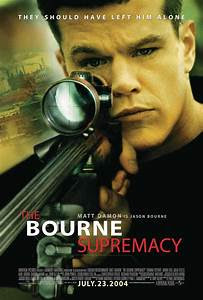
 The film version of The Bourne Supremacy was released stateside on July 23, 2004. Paul Greengrass directed the film, from a script by Tony Gilroy.

  Matt Damon reprised his role of Jason Bourne. Franka Potente reprised her role of Marie St. Jacques. Brian Cox reprised his role of Ward Abbott. Julia Stiles reprised her role of Nicolette "Nicky" Parsons. Gabriel Mann reprised his role of Danny Zorn. Joan Allen played Pamela Landy. Karl Urban played Kirill. Michelle Monaghan played Kim. Tom Gallop played Tom Cronin.