Showing posts with label Lorraine Gary. Show all posts

Tuesday, June 28, 2022

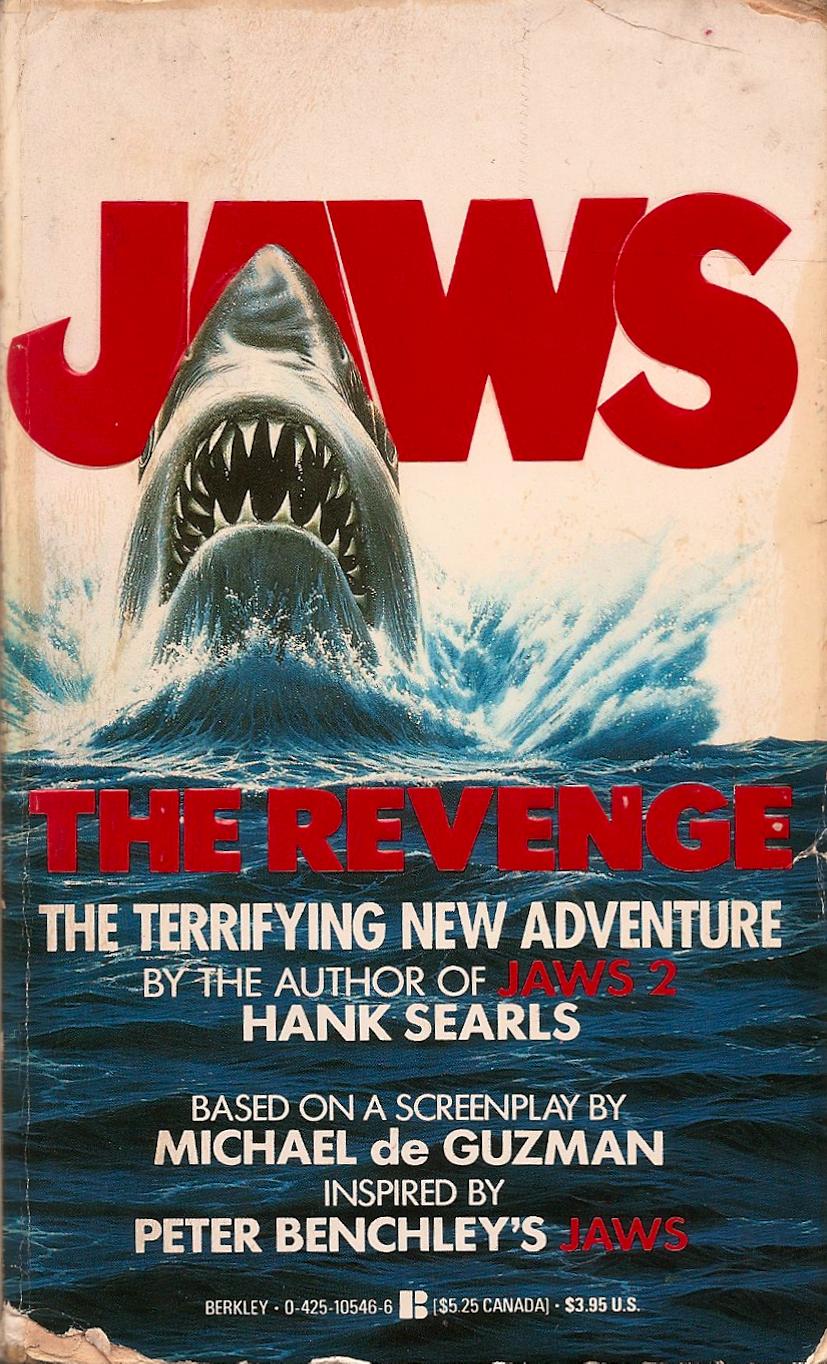
Jaws: The Revenge by Hank Searls


(pb; 1987: movie tie-in, based on Michael De Guzman’s screenplay)

From the back cover

“This time it’s personal.

“The lives of the Brody family have been devastated by a natural force.

“A force that glides, silent and unseen, beneath the ocean surface—ready to strike out with a relentless fury.

“To Ellen Brody it is evil incarnate. And it must be destroyed. Once and for all.

“Even if it costs Ellen her life.”


Review

Twelve years have passed since the events of Jaws. Martin Brody died a few years ago, a heart attack—his heart was weakened by the shock he was jolted by while electrocuting the great white shark ten years prior, in Jaws 2. Now Ellen, his wife, is a nervous wreck, especially when Sean, Ellen and Martin’s second, youngest son, goes out to remove an obstruction from the Amity harbor one December night. Then another great white, spawn of the previous two killer sharks, eats Sean, a police officer like his dad.

This spirals Ellen further into grief, fear, rage and more than a touch of craziness. She allows her eldest son Michael, a marine biologist (much to her dismay), to take her to the Whiskey Cay/Prince George Town areas in the Bahamas. The shark follows the tides (hello, El Niño) to where Ellen is—to the hysterical widower and bereft mother, it smacks of grim and terrifying destiny.

Searls’s writing, as it was with his Jaws 2 novel, is solid and cinematically visual. Unfortunately, this third book outing in the Jaws franchise* saddles the worthwhile author with a ridiculous set-up and an annoying lead protagonist (Ellen), undermining most of the thrills and other pleasures Revenge might’ve had. Revenge is also undercut by a subplot involving Papa Jacques (a voodoo priest who has a grudge against Michael Brody and a psychic link with the flesh-rending shark)—another ridiculous conceit, one that the tightly edited film (credit Michael Brown for that) eschews. The film version, keeping with franchise tradition, also cuts out the book’s Mafia B-storyline (this time it’s a subplot about pilot Hoagie Newcombe and Bahaman drug smugglers, particularly the murder-happy and over-the-top Rico Lomas).

Revenge’s climax, with its cross-cut editing (somewhat reflected in the movie), is especially well-written and gripping, despite Ellen’s hysteria, the shark’s voodoo connections, and Ellen/the film-version’s conceit that the shark followed her to the Bahamas—at least Searls tried to provide a reasonable rationale for why the shark did the latter, something the movie version barely bothered with.

If you’re looking for the bookish thrills of the two previous novels, skip Revenge, and pretend the story ended with Jaws 2.

The film version was released stateside on July 17, 1987.


(*There were four movies. Revenge’s film version was preceded by Jaws 3-D, 1983, which was not novelized.)

Sunday, January 16, 2022

Jaws 2 by Hank Searls


(pb; 1978: loosely linked movie tie-in novel. Sequel to Peter Benchley's Jaws.)

Review

Caveat: possible (mini-)spoilers in this review.

Story: a year after the shark attacks (called “The Trouble” by Amity citizens), a local female shark impregnated by the one in the first book, follows oceanic currents back to the tragedy-beleaguered town, and a new cycle of nautical terror begins.

Searl’s well-written, entertaining sequel expands on the themes, characters, and events of Peter Benchley’s 1974 novel rather than the stripped-down film version of Jaws. Like Jaws, the book and film versions of Jaws 2 are considerably different from each other─and separate entities, despite their common elements. This first book sequel to Benchley’s work is a good beach read, one worth owning.

Followed by Hank Searls’s Jaws:The Revenge.

Differences between Searl’s novel and the Jeannot Szwarc-helmed movie include:

The book is grittier, darker, and has more gore than its filmic counterpart, and the shark is more sympathetic in the book, as she’s pregnant and starving (something that’s not mentioned in the movie, which treats the shark as another random stroke of bad luck for Amity). The book’s backstories also make the second shark’s return more believable.

In the film, Martin Brody knows about the new shark early on. In the book, he suspects there might be one, but is not given proof of it until near the end.

Searls expands on Benchley’s mafia/corruption subplot, with a summer-tourist regular, Shuffles Moscotti─big-time gangster─quietly, through illegal channels, investing in an Amity casino that could save the town from economic ruin, a downward trend started by the first shark. Moscotti, through his actions, is a major character in the book. The film version of Jaws doesn’t mention Moscotti or the casino.

Another character, Charlie Jepps─baby seal-shooting tourist cop from Flushing, New York─is only in the book. (Seems he didn’t know about the Marine Mammal Protection Act of 1972, which dictates a yearlong imprisonment and a “twenty grand” penalty fine.)

In the film, the water-skiing tourist (a woman) and the boat driver (a woman) are killed by the shark attack and resulting boat explosion. In the book, it’s the boat driver is a man, the skier his wife.

#

The streamlined sequel film, which eschews at least half of the book’s story (to its cinematic detriment), was released stateside on June 16, 1978. Jeannot Szwarc directed it, from a screenplay by Carl Gottlieb and Howard Sackler.

Roy Scheider reprised his role of Martin Brody (from Jaws, 1975). Lorraine Gary reprised her role of Ellen Brody. Mark Gruner played Mike Brody, the Brodys’ adolescent son. Marc Gilpin played Sean Brody, their younger son.

Jeffrey Kramer reprised his role of Len Hendricks. Murray Hamilton reprised his role of Mayor Larry Vaughn. Joseph Mascolo played Peterson.

Keith Gordon played Doug, the book-nerdy friend of the popular teens. Donna Wilkes played the often-screaming Jackie, the bad-influence girl who’s caught Mike Brody’s attention.


Monday, December 06, 2021

Jaws by Peter Benchley


(pb; 1974)

Review

This is one of my all-time favorite pulp-thriller novels, a hard-to-set-down, entertaining mix of pulpy corruption, class warfare, a killer monster, character development and cinematic-vivid (without becoming verbose) writing. Obviously, given its setting, this is a great beach read, one worth owning (I’ve re-read it three times in four decades, and been wowed anew every time).

Followed by Hank Searls’s notably-different-from-the-film Jaws 2.

NoteThe novel is considerably different than its streamlined 1975 film version, by having Martin Brody as a native of Amity, Long Island (in the film he’s “not an islander. . . [he's] from New York”). The book, which may upset those sensitive to bad things happening to cute land animals, also has equal-to-shark-time focus on corrupt mayor/real estate agent Larrry Vaughan (it’s Vaughn in the movie) and his likely criminal “silent partners.” A subplot about a key character’s infidelity and Amity’s history is also highlighted, as well as how the Brodys have three sons (not two, like the film version) with different fates for one of the main characters.

#

The resulting film was released stateside on June 20, 1975. Steven Spielberg directed the film from Carl Gottlieb’s screenplay (Gottlieb also played Harry Meadows in the film).

Roy Scheider played Brody. Robert Shaw played Quint. Richard Dreyfuss played Matt Hooper.

Lorraine Gary played Ellen Brody. Chris Rebello played Michael Brody. Jay Mello played Sean Brody.

Murray Hamilton played Larry Vaughn. Peter Benchley played an “Interviewer.”